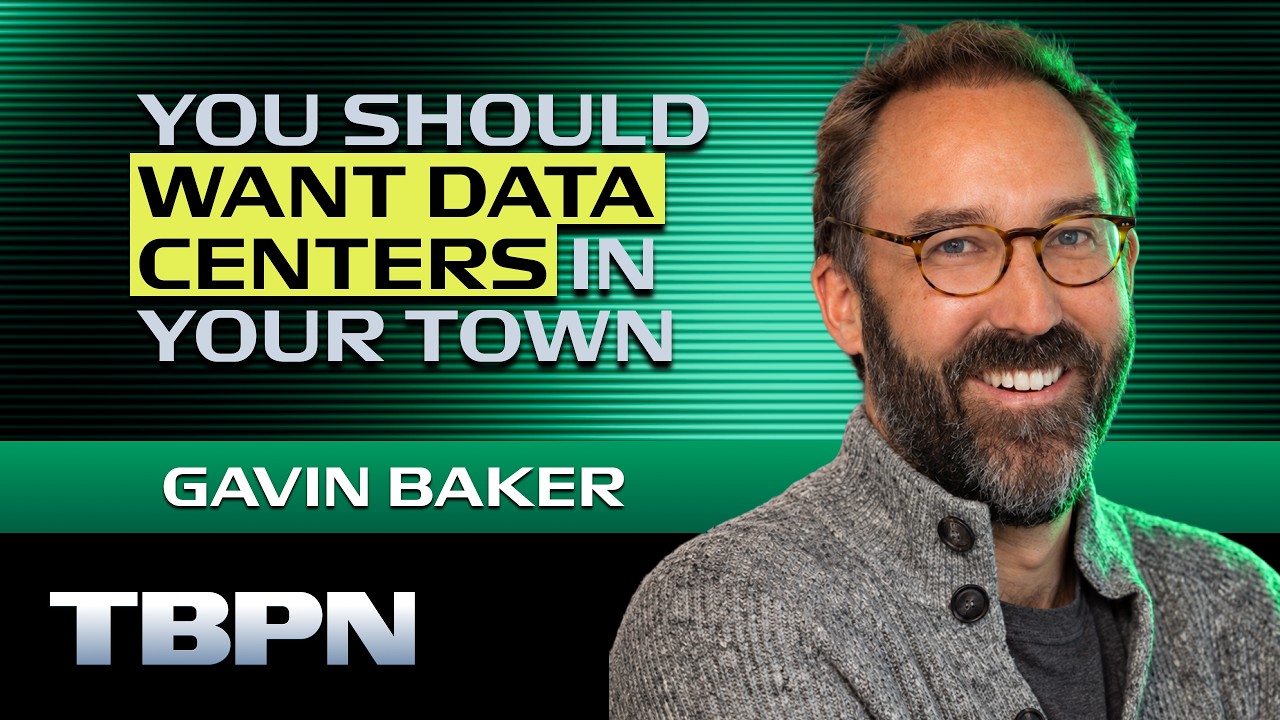
Recorded 28 October 2026 · 41 min
Gavin Baker, managing partner of Atreides Management, argues that AI demand is further from saturation than the market assumes. Enterprise adoption is still early, and the forward price of compute now sits above the spot price, so a cluster wanted in late 2027 is both expensive and hard to find. He made the case on a technology talk show during the week Anthropic filed its S-1, which he calls a clear upside surprise.
The conversation tests that optimism. A host cites Ramp data showing heavy spending concentration. Baker answers that the S-1 is more authoritative and shows a diversified base, while conceding Ramp may be right for AI overall. He also relays a bearish argument that Anthropic's 74% training allocation could flood the inference market if training needs fall. Beneath it all is a financing question: who pays for the 2027 buildout, and who can actually energize the hardware.
S-1 upside surprise — ▶ 0:48
Baker read Anthropic's S-1 as a clear upside surprise: cash burn of only $10 billion, with encouraging profitability, cash generation and unit economics. His most striking statistic is penetration. Roughly half of the Fortune 500 have adopted Anthropic, yet it represents about 0.1% of their expenses. He cites roughly $67 billion in annualized revenue, though he was unsure of the exact figure and described it as the reported third quarter annualized. His conclusion is that enterprise diffusion is earlier than even he had assumed, which implies this scale was reached on shallow adoption.
Concentration versus diversification — ▶ 2:38
Hosts raised the standard bear point that a few companies drive most AI spending. They cited Ramp data showing 1% of companies spending about 90% of the dollars, and a New York Times report that 80% of Anthropic's revenue came from eight customers. Baker countered that the S-1 is more authoritative and shows a diversified base. Figures raised in the exchange put 250 accounts above $10 million and 11,000-12,000 above $100,000. He conceded that Ramp may still be correct for AI spending overall.
Open-weight clouds outgrowing labs — ▶ 5:16
Baker says Fireworks, Baseten, Together, Modal and Cognition, all open-weight first and at scale, are growing faster than either OpenAI or Anthropic. That held during OpenAI's summer acceleration and still holds in October. His firm led Fireworks' last round and found it hard to price because revenue kept rising, so the effective multiple fell daily. He also reversed his summer view that Anthropic was losing share. He now sees reacceleration, inferring partly from the S-1 leaving a blank for October ARR, which he doubts would happen unless the number was strong.
Grockbot as workflow engine — ▶ 8:49
Baker calls Grockbot the most impactful AI product he and his firm have used. After stitching workflows together with Claude Code, which he blames partly on user error, he found Grockbot far easier. He now runs about 17 of them and adds a new one daily. Its value, he says, is getting the right information to the right person at the right time, which he describes as much of investing. He sees personal-assistant products as less useful to him because he has an exceptional human assistant. The claim is one power user's testimony, not adoption data.
Compute curve in contango — ▶ 12:53
The price to rent essentially any GPU rose every day in October. Silicon Data founder Carmen Lee said at GTC that the compute market is in contango: forward prices exceed spot, so a cluster wanted a year out costs far more. Baker, whose firm invests in Silicon Data, says portfolio companies that got 4,000 Blackwell GPUs in May or June 2026 and want another cluster in September 2027 are shocked by the price. Compute is hard to source well into 2027. Commodity analysts expecting backwardation, he says, are wrong, and he thinks public markets are not reading the signal.
Fixed-price contracts leak value — ▶ 15:05
CoreWeave runs GPUs well, Baker says, but locked a vast amount of compute into long-term contracts now well under market, and is trying to add spot exposure. He thinks Elon Musk, reasoning from first principles, concluded prices were rising. Selling into the spot market allows paybacks well under a year and large prepayments, which Baker sees as a better financing model for this market. Per Baker, Sarah Friar said committed compute could be sold at a 3x to 5x premium today. In a rising market, fixed-price supply contracts hand value to the buyer.
Energizing GPUs is the bottleneck — ▶ 16:51
Baker likens standing up a GPU cluster to running a Formula 1 team. Many entrants with land, power and a zero-down offtake agreement lack the experience. He hopes tight financing steers GPUs to operators who can energize and run them, naming CoreWeave, Crusoe, Nebius, SpaceX and the hyperscalers. The DSX pod, a new product from Jensen announced at GTC, ships as seven pre-assembled racks and could shrink the three to six months many customers need to energize GPUs. That delay could idle hundreds of billions of dollars of assets, so cutting it releases working capital.
AI's image problem — ▶ 22:15
Baker says the AI industry scores negative 5 out of 100 on public relations and needs to tell better stories. His example is a friend who used AI to find that a drug in use for 50 or 60 years could effectively cure a devastating rare disease affecting about 10,000 kids a year. The story is not his to tell, so it cannot be verified here. On data centers, he notes that Loudoun County, the wealthiest in America, has the highest per capita data centers. He argues the buildout is re-industrializing America and expanding electrical generation.
Training-heavy bear case — ▶ 28:00
Baker engages a bearish post from an LBO analyst: Anthropic dedicates 74% of its compute to training. That is bullish because the capacity could generate more revenue. It is bearish because if anyone concludes less training compute is needed, a large block of supply could hit the inference market. Baker called it a compelling bearish argument and says he reads critics to learn, not to be right. He offers no rebuttal on this specific point, and the discussion supplies no evidence on whether training needs will rise or fall.
Public listings unlock capital — ▶ 35:30
Baker calls American mutual funds an underappreciated source of buying power. He describes them as limited in how much of a portfolio they can hold in private positions (the transcript wording is garbled). Once SpaceX and Anthropic are public and shares unlock, that constraint eases. Sovereigns, especially in the UAE, have been very active: his firm co-led Crusoe with Mubadala, and Apollo is taking a stake in Mubadala. His answer to who becomes the marginal capital source in 2027 is, in effect, the existing participants in greater size, not a new class of investor.
Cash flow funds 2027 — ▶ 37:04
Baker predicts clouds will reprice underpriced contracts higher and add spot capacity. After a pronounced acceleration last quarter, he expects continued acceleration in combined cloud revenue growth at the big hyperscalers and neoclouds. Because that revenue drops down at very high margins, operating cash flow should follow, and he thinks it could finance more of the 2027 buildout than people expect. He does not claim external financing has peaked, but thinks it is close. This is a forecast, and no supporting figures were offered.
Gavin Baker's central claim is that the binding constraint in AI is supply, and that the best evidence is not any company's revenue but the shape of the price curve for compute. He says the market for renting GPUs is now in contango, meaning prices for future delivery exceed spot prices. That is the opposite of the backwardation that commodity analysts have been writing about on X, and it changes what a coming wave of new capacity means. In October, Baker says, the price to rent essentially any kind of GPU rose every day. More telling, a customer who wants a cluster a year from now must pay far more than one who wants it today.
The evidence comes from Baker's own vantage point, which is worth stating plainly. His firm invests in Silicon Data, whose founder Carmen Lee made the contango observation at GTC. Beyond that, Baker describes portfolio companies that secured a cluster of 4,000 Blackwell GPUs in May or June 2026 and now want a second, equal-sized cluster in September 2027. They are shocked by the price, and finding compute well into 2027 is hard. Baker adds that Sarah Friar has said committed compute could be resold at a 3x to 5x premium. He thinks public markets are missing all of it; it is, he says, "not legible to the public markets." Whether markets have missed the signal or read it differently, the discussion does not settle.
The demand half of the argument rests on Anthropic's S-1, which Baker read as an upside surprise. A cash burn of only $10 billion, with encouraging profitability and unit economics, undercut the fear that the economics were failing out of view. The statistic he returns to is penetration. Roughly half of the Fortune 500 have adopted Anthropic, yet it accounts for about 0.1% of their expenses. He also cites about $67 billion in annualized revenue, while admitting he was unsure of the exact number. A host noted that the other half of large companies have not worked through the hiccups of deploying AI. The editorial inference is that revenue to date was built on early adopters, so Baker's view that diffusion is earlier than he thought is a statement about future headroom as much as present scale.
The strongest challenge to that story is concentration. A host pointed to Ramp data suggesting that 1% of companies account for about 90% of AI dollars, and a New York Times report said 80% of Anthropic's revenue came from eight customers. Baker replied that the S-1 is far more authoritative, and that it shows a diversified base. Figures raised in the exchange put 250 accounts above $10 million of spend and 11,000-12,000 above $100,000. He conceded that Ramp could still be right about AI spending overall. The disagreement is narrower than it first appears. The discussion accepts that a few AI-obsessed companies are far ahead. The live question is whether Anthropic's own customer base is already broad, and the S-1 figures cited favor Baker on that point.
Diversification, Baker argues, extends beyond Anthropic. He says open-weight-first companies including Fireworks, Baseten, Together, Modal and Cognition are at scale and growing faster than either OpenAI or Anthropic. That held during OpenAI's summer acceleration and remains true in October. His firm led the last Fireworks round, and pricing it was difficult because revenue rose so fast that the effective multiple fell every day. Baker also revised his view of Anthropic. In the summer he judged it to be losing share; now he sees reacceleration. He partly infers this from the S-1 leaving a blank for the October ARR, which he doubts the company would have done without knowing the number would be strong. That is an inference about management behavior, not a disclosed figure.
If compute is scarce, contract structure matters as much as hardware. Baker says CoreWeave runs GPUs well and its clusters are reliable, but it locked a vast amount of compute into long-term contracts now well below market. It is now trying to add spot exposure. He believes Elon Musk, reasoning from first principles rather than studying anyone else, reached the opposite conclusion: prices are rising, so sell into the spot market, collect large prepayments and earn paybacks well under a year. The same logic explains why Baker says any long-term compute contract signed before May 2026 is deeply in the money. The strategic lesson, which follows from his account, is that in a rising market fixed prices transfer value to the buyer, while variable pricing keeps it with the supplier.
Scarcity also changes who can participate. Baker compares standing up a GPU cluster to running a Formula 1 team: logistics, people and strategy all have to work at once. Many entrants with land, power and a zero-down-payment offtake agreement lack that experience. He hopes tight financing acts as a forcing function that allocates GPUs to operators who can energize and run them, and names CoreWeave, Crusoe, Nebius, SpaceX and the large hyperscalers as proven. He adds that the future is uncertain. The DSX pod, a Jensen product announced at GTC, ships as seven pre-assembled racks. If it cuts the three to six months many customers need to energize GPUs, Baker says, it removes working capital from the system, because that delay could mean hundreds of billions of dollars of idle assets.
On financing, Baker expects the marginal source of capital to broaden. American mutual funds, he says, face limits on how much they can hold in private positions, so SpaceX and Anthropic going public would free up substantial buying power once shares unlock. The transcript wording here is garbled, so the exact constraint is uncertain. Sovereigns, particularly in the UAE, have been front-footed, and his firm co-led a Crusoe round with Mubadala. He then makes a forecast. As clouds reprice old contracts and add spot capacity, he expects combined hyperscaler and neocloud revenue growth to keep accelerating at very high margins. Operating cash flow could then fund more of the 2027 buildout than people expect. He does not know whether external financing has peaked, only that it is close, and he offers no figures to support the estimate.
Baker is also an advocate, and says so. He argues the AI industry scores negative 5 out of 100 on public relations and should tell better stories. His example is a friend who used AI to show that a decades-old drug could effectively cure a rare disease affecting about 10,000 kids a year. He declined to tell the story, so it cannot be checked here. He points to Loudoun County, the wealthiest in America, which also has the highest per capita data centers. The hosts speculated that Anthropic and OpenAI going public could moderate X sentiment by widening share ownership beyond perhaps 50,000 people. Baker, for his part, favors giving shares directly to individuals.
The most useful moment may be Baker's treatment of the bear case. He relays an LBO analyst's point that Anthropic dedicates 74% of its compute to training. Read one way, that is bullish, since the capacity could earn more revenue. Read another way, it means that if anyone decides less training compute is needed, a large block of supply could hit the inference market. That is the mechanism by which a shortage turns into a surplus. Baker calls the argument compelling but gives no rebuttal and cites no data on future training needs. The forward curve he points to reflects what buyers expect today, and the question is whether it survives the arrival of 2027's supply and any change in training demand.
The open question. Baker's scarcity case rests largely on one investor's portfolio anecdotes and a data provider his firm backs, set against a wave of new supply. If Anthropic's 74% training allocation is any guide, how much of today's tightness is durable inference demand rather than training capacity that could be cut? That is the point where scarcity could turn into surplus, and the discussion offers no evidence on it.
Watch the full video at https://www.youtube.com/watch?v=crdg4X5BZPc.
Comments ()