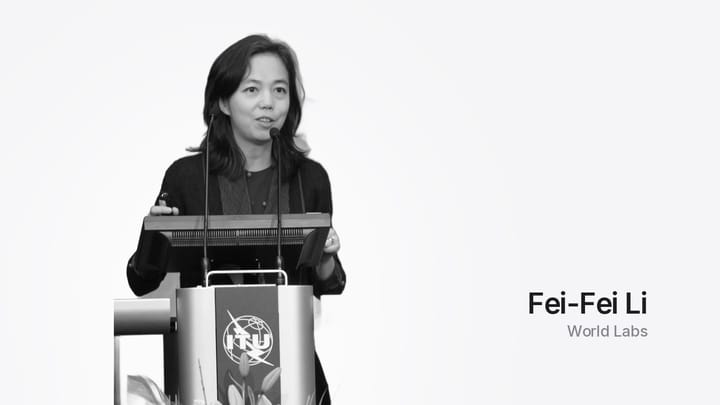

Recorded 21 Oct 2026 · 50 min
Fei-Fei Li argues that intelligence is multidimensional, and that language is the newest and thinnest layer of it. Language is a few hundred thousand years old. Perception-driven intelligence is a half-billion-year project that began when trilobites first saw light. That is her case for spatial intelligence as the next frontier of AI after large language models, and the reason she co-founded World Labs in 2024.
Li is a Stanford professor and co-founder of World Labs. She talks with historian of authoritarianism Stephen Kotkin at the company's San Francisco headquarters for an "Only in America" series. The conversation runs from her arrival in Parsippany, New Jersey, at 15 with $20 and no English, through Princeton physics and her pursuit of an "audacious question", to the company she runs now.
The tension is between freedom and its side effects. Li credits freedom and curiosity for everything she has built. She also admits that the same technology that simulates worlds for robots and surgeons can fabricate deepfakes, and that productivity gains do not guarantee shared prosperity.
$20 and no English — ▶ 4:30
Li landed in Parsippany, New Jersey, at 15 with her parents, $20, no English and no contacts. The family worked whatever jobs existed. She and her parents were cashiers, cleaners and restaurant takeout workers, and her mother's health was very bad. At first "there seemed to be no opportunities." Thirty-plus years on, she defines opportunity as something that is not handed to you. It is a place that lets you "work so hard to dream big or small and to seize those opportunities."
Einstein as the pull — ▶ 6:59
Li applied to Morris County College and Rutgers, but "had to apply to Princeton" because Albert Einstein had been there. Physics was her first love as a teenager, and she dreamed about it while working shifts. In her first week at Princeton, a professor said Einstein used to sit in her lecture room seats. Her reaction: "I just felt like I died. I went to heaven." The aspiration pointed at a person and a question, not a prestige ranking.
Parents who didn't push — ▶ 8:02
Her parents did not check homework or ask about colleges, partly because they did not know how and were trying to survive. They also never told her to become a doctor or accountant because they were poor. They never suggested that special relativity was a poor way to make money. Her father brought curiosity to free parks and to yard sales run like scavenger hunts. She calls it "a gift that I didn't know it was a gift" until she grew up.
The audacious question — ▶ 12:15
What Li loved in physics was the audacity to ask the hardest questions, not the equations. Her junior paper and senior thesis forced her to name her own question. Einstein, Schrödinger ("What is Life?") and Penrose ("Emperor's New Mind") had all turned beyond the atomic world later in their careers. She chose intelligence: can machines be intelligent? She did not know it was Alan Turing's question from the 1940s. At Caltech she ran a dual track in computational neuroscience and AI.
Courage with nothing to lose — ▶ 16:40
Curiosity alone is not enough, Li says. It needs courage and fearlessness, which she credits to her parents and millions of immigrants. With no path to follow and no language, "you almost have nothing to lose." Freedom, in her telling, gives agency: you must survive and thrive on your own. She sees immigrants and scientists as doing the same thing, crossing boundaries. Immigrants cross linguistic and cultural ones. Scientists cross between the known and unknown, neuroscience and computer science, technology and the humanities.
Pursuing truth, not holding it — ▶ 22:02
A scientist's first moral responsibility is to pursue truth, Li says. She stresses that doing science does not mean you know the truth. Rigor means instruments, debate and review. She denies technologists any "moral high ground of truth or even the methodology of truth." Physics and computer science are comparatively clean and deterministic, while the human world is "way messier." She respects the humanities because their pursuit of truth must handle things that cannot be measured, and she says the line between scientist and person blurs for her.
Same tech, deepfakes — ▶ 26:02
Kotkin says science's own techniques are putting the truth regime under siege through deepfakes. Li concedes it without argument. The technology that simulates environments for robots and self-driving cars, and molecular pathways of viral infection, can also produce deepfakes. Her generation built it. Her response is humility, plus co-founding Stanford's Institute for Human-Centered AI to bring everyone in to harness the tools and avoid harm. She calls it messy but unavoidable as humanity invents more powerful tools. She offers no technical fix.
Spatial intelligence thesis — ▶ 28:59
World Labs was founded in 2024 with three other co-founders, about two years after ChatGPT. Li argues that much of human work sits beyond language. That includes interacting with the 3D world, designing homes, factories, cities and big machinery, creating, and simulating and training from surgeons to athletes. She calls this spatial intelligence. The goal is a frontier model company serving creators, robotics, healthcare, education and enterprise. The thesis grew from her Stanford computer vision and robotics research, after building ImageNet. Her first company was a dry cleaning shop.
Evolution's order of operations — ▶ 34:57
"Intelligence is multidimensional," Li says, and evolution shows it. Sophisticated language is a few hundred thousand years old. Sensing and perception began a half-billion-year journey under the ocean, when trilobites saw the first light. Sight made predator and prey the central force of evolution, and intelligence grew more complex under that survival pressure. It includes seeing, touching, planning, communicating and reasoning in 3D, and imagining what comes next "spatially as well as semantically." Fully realizing AI therefore takes a multidimensional approach.
Teachers left behind — ▶ 41:59
Li says America is founded on change, and this change is cultural, demographic and technological. What pains her most is that K-12 and even K-16 teachers, and parents, have not been reached by the conversation about technological and civilizational change. She goes to Washington, DC, from Stanford's HAI to argue for resourcing the public sector and academia. Her reason is that they produce public goods: talent and truth-seeking work on cancer, economic models, jobs and societal structures. She worries society is not responding to the change in the most optimal way.
Productivity isn't prosperity — ▶ 47:16
Li argues that this wave of technology is more profound than the science-driven change several hundred years ago that produced the Enlightenment. It goes directly into the human cognition layer and changes work, learning and communication, with cultural, political and economic change downstream. Her sharpest line is that improved productivity "absolutely does not guarantee shared prosperity." Kotkin adds that 48 million people, about a fifth of the US, are foreign-born, and that if America is open to the world it has to actually be open. Li agrees that the future is yet to be invented.
Language models have captured the dimension of intelligence that arrived last. Li treats that as an opening, not a criticism. Much of what people do sits outside words: moving through a 3D world, designing a home, a factory or a city, running big machinery, training for work from surgery to sport. She groups all of it under spatial intelligence. World Labs was founded in 2024 with three other co-founders, about two years after ChatGPT, to build a frontier model for it. The customers she names are creators, robotics, healthcare, education and enterprise.
The argument behind the product is biological. Intelligence did not start with talk. It started when animals first sensed light and touch. Sight made predator and prey the central force of evolution, and intelligence grew more complex under that pressure. Seeing, touching, planning and reasoning in three dimensions all came long before the thing language models imitate. Kotkin adds a sharp observation. A model can do words as well as he can, maybe better, and still not be how intelligence works. The debate over whether that counts as intelligence looks strange to him. Li's reply is that intelligence includes imagining and predicting what comes next, in space as well as in meaning. That is the product brief.
Is the thesis credible? Her record says so. She built ImageNet, a data set of 50 million images, while facing the usual pressures of tenure, publications and expectations. Kotkin's framing is that the neural network breakthroughs of Geoffrey Hinton and Yann LeCun needed data, and she supplied it. Spatial intelligence is the second leap of the same kind, from images to 3D. Li says the thesis came from years of computer vision and robotics research at Stanford. She also says she simply loves building. Her first company was a dry cleaning shop.
The habit of choosing the hardest problem is older than any of that. What she loved in physics was not the equations but the audacity of the questions. When Princeton forced her to pick a junior paper and senior thesis, she asked what her own question was. Einstein, Schrödinger and Penrose had all turned toward humanist questions later in their careers. She settled on intelligence. She did not know it was Alan Turing's question. At Caltech she ran computational neuroscience and AI side by side, and she says she never left the dream.
She traces the nerve to being an immigrant. She arrived in Parsippany at 15 with $20, no English and no contacts. Her parents took whatever jobs they could find, and her mother's health was poor. They did not push her, because they did not know how. They also never told her to become a doctor or an accountant, even as she fell for special relativity. Her father found curiosity in free parks and in yard sales run like scavenger hunts. With no path to follow, "you almost have nothing to lose." Freedom, in her telling, is less the absence of constraint than agency: you have to survive and thrive on your own. She sees immigrants and scientists as doing the same work, crossing boundaries, whether linguistic, cultural, or between neuroscience and computer science.
The obvious objection comes from the same room. A company that builds models of the physical world also builds tools for faking one. Kotkin puts it directly. Science's own techniques are putting the truth regime under siege through deepfakes. Li does not contest the premise. The technology that simulates environments for robots and self-driving cars, and molecular pathways of viral infection, can be used for deepfakes. Her generation made it. Her answer starts with posture. Scientists pursue truth. They do not possess it. "Science doesn't mean it's truth." Technologists, she says, have no moral high ground on the methods of truth. She respects the humanities because their pursuit is messier and involves things that cannot easily be measured. Her institutional move was to co-found Stanford's Institute for Human-Centered AI, to bring everyone in to harness the tools and avoid harm. Kotkin sums it up: respect and humility, but the striving remains.
The same logic scales up. Li argues this wave is bigger than the science-driven change several hundred years ago that produced the Enlightenment. It reaches directly into the cognition layer and changes work, learning and communication. Cultural, political and economic change follow downstream. Then comes the line she is firmest about: "improved productivity absolutely does not guarantee shared prosperity." Her concrete worry is education. Teachers from K-12 through college, and parents, have not been reached by the conversation. Her concrete ask is funding. She goes to Washington to argue that the public sector and academia need resources, because they produce public goods such as talent and truth-seeking work on cancer, jobs and economic change. Kotkin adds that 48 million people, about a fifth of the United States, are foreign-born, and that being open to the world has to mean actually being open.
Now the harder reading. Every answer on risk is a posture or a convening. Asked about the truth regime, she offers humility and an institute. Asked what in America falls short, she says society is not responding to this change in the best way, and names no policy. Asked about civic responsibility, she says she does not think of herself as a platform, and describes mentoring a company whose people are all younger than her. These answers are sincere. They are not mechanisms. The conversation never says who should resource the teachers, or what a World Labs model will be built to prevent. It never says how the benefits promised to creators, robotics and healthcare reach people if productivity does not guarantee shared prosperity. The evolutionary case for spatial intelligence is clean. The case for who benefits is a worry stated without a plan.
The open question. Li answers the hardest question put to her, how science copes when its own tools erode the truth regime, with humility and a convening institute rather than a mechanism. The same pattern holds on education and shared prosperity: she names the problem and the need for public funding but no plan. The claim worth testing is whether spatial models that simulate worlds can be built with harm avoided by design. Watch what World Labs ships and what safeguards come with it.
Watch the full video at https://www.youtube.com/watch?v=hHlpUt7Cqg8.
Comments ()