Recorded 28 October 2026 · 40 min
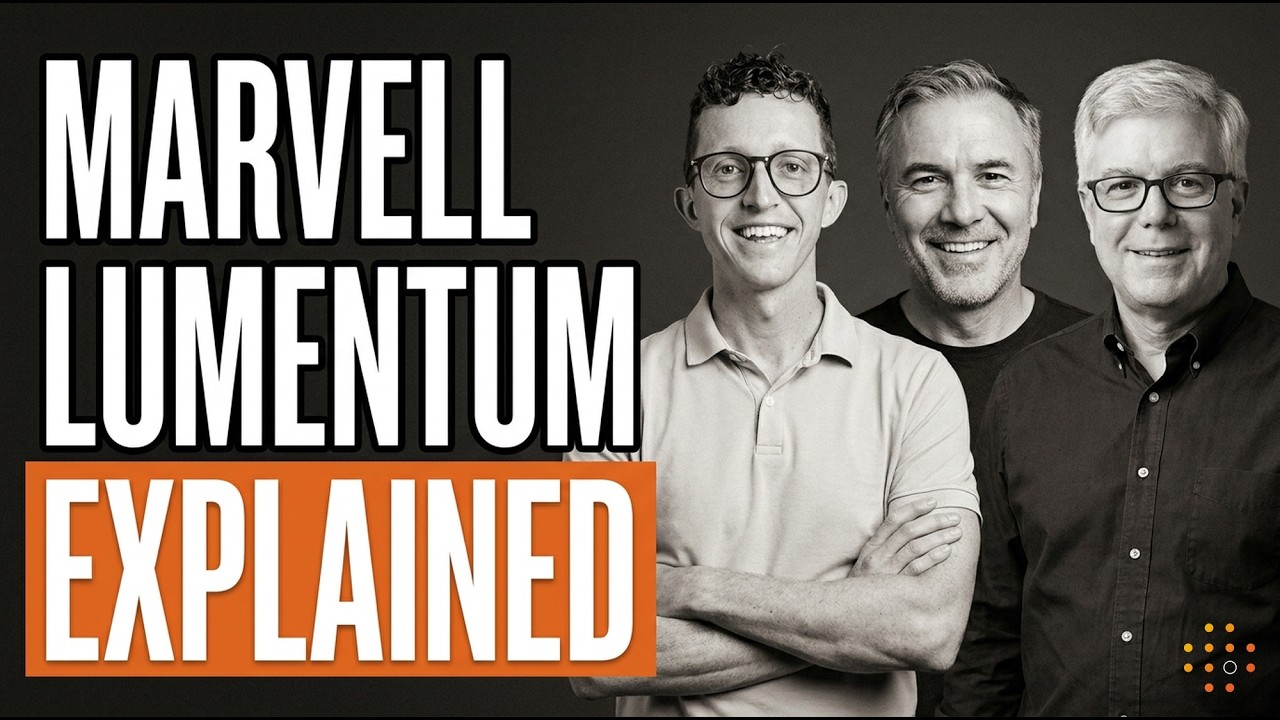
Andrew Smith and Scott Wilkinson of Signal AI, a market research firm serving optical networking suppliers, argue that the reported Marvell–Lumentum deal is best read as a vertical integration play, not a bid to secure laser supply. Bloomberg reports that Marvell, valued at about $221 billion, is in advanced talks to buy Lumentum, valued at about $83 billion. An announcement could come as soon as next week, and the deal would rank among the 10 biggest tech and telecom mergers ever.
The tension is that Marvell sells DSPs to the same module makers it would then compete against, and no company has yet combined DSPs, lasers and datacom modules. The analysts say they had not discussed the news with each other before recording and have no inside knowledge. They work through whether the trade is worth making, and why Lumentum would sell at a moment of strength.
Two suppliers remain — ▶ 6:29
Ten to 15 years ago there were at least seven or eight small optical component companies. Consolidation has left Coherent and Lumentum as the two biggest suppliers, excluding Chinese assemblers. As these components became more valuable, the analysts say, controlling development and the supply chain became essential in a fast-moving market, which means owning both chips and optics. Marvell would be the first company to hold DSPs, lasers and modules at scale. They name Acacia as the closest analog, though not at this scale. Broadcom's optics unit, outside its CPO work, operates at arm's length from the rest of its business.
Not a capacity play — ▶ 10:37
The theory that Marvell is buying laser capacity is dismissed. Marvell purchases only tunable coherent lasers for its ZR modules, from suppliers it has strong relationships with, and its CPO startup partner does not need Lumentum-scale supply. Lumentum has expanded indium phosphide capacity twice, a doubling and then another, and can serve outside customers without Marvell's help. Because Marvell makes no datacom transceivers, the lasers would be both source and sink internally, so no new demand appears. Smith and Wilkinson see no link between the deal and fab expansion.
Competing with your customers — ▶ 11:49
Marvell's coherent DSPs sit inside most 400G modules, except those from Acacia, Ciena, Nokia and Chinese vendors such as Huawei. One module supplier told Signal AI it will have to exit the market because it cannot compete with a vertically integrated rival that supplies its DSP. Datacom has been different, because Marvell has sold DSPs to everyone and never built a module. Wilkinson says no company has built a DSP, used it internally and sold it externally. Lumentum has done this with lasers, but DSPs are harder. Volumes are so large that the effect may not matter in the short term.
Where transceiver value sits — ▶ 14:03
Lumentum's Cloud Light acquisition shows the economics. In a silicon photonics datacom transceiver, Lumentum supplies its own CWDM laser and manufactures the optical front end. It buys a PAM4 DSP from Broadcom, Marvell or another vendor. Those two elements, the optics and the PAM4 chip, are almost all of the transceiver's value. A DSP supplier selling to a module-making competitor has little reason to price the chip so that it can be undercut. Customers still have alternatives, including Broadcom, Nvidia and Credo. Marvell would still be the first fully integrated datacom player.
Trading parts for systems — ▶ 15:37
A host suggests that Marvell may accept losing some DSP share to sell complete modules to hyperscalers, especially as NPO and CPO need less DSP. Smith agrees that integrating captures more value than selling piece parts, even at lower unit volume. He adds that Lumentum brings OCS, where only one supplier ships at major volume and which he expects to become critical data center infrastructure within 5 to 10 years. It also brings high-power lasers for CPO and NPO, which fit Marvell's move toward photonic integration. Wilkinson's quip: anyone whose business card says DSP salesman should be a little worried.
Why Lumentum would sell — ▶ 18:28
The analysts decline to assess valuation, but guess that an offer reported to be beyond 10x current revenue is hard to refuse. They note that CEO Michael Hurlston previously ran Finisar for a short period and arranged its sale to Coherent. Wilkinson thinks Lumentum may be worth as much or more to another integrator, citing Nvidia's Mellanox purchase. Nvidia has put $2 billion into Lumentum and also invested in Marvell and Coherent. As equity holdings, the analysts see this as no obstacle. They also say post-merger customer behavior depends on how Marvell manages the integration.
Margin dollars over percentages — ▶ 23:25
Optical components once sold at roughly 25% gross margins and now fetch almost double. Wrapping sheet metal around them lets a supplier capture more gross margin dollars, and controlling optics, chips and system allows tighter co-development. Smith has argued for chip-laser combinations for over 10 years. The obstacle was investor fixation on percentages, since a chip company with 50% gross margins would be punished for buying a business at 25-30%. Marvell could have bought Lumentum for $3 billion six or seven years ago and may now pay about 30 times that. Lumentum's rare devices, the analysts say, cannot be sold at 25%.
Volume beats being first — ▶ 29:20
Wilkinson describes an Ethernet-standard lottery. Five or six companies build to a new standard, but within a few years two companies ship 80-90% of volume. Smith argues that today's version rewards capacity, not just speed. Being first with 10,000 units loses to being second with a million. Eoptolink came late to 800G Ethernet and is now, he says, number two worldwide because it could build in volume. The same pattern is emerging at 1.6T. He ties this to capacity constraints, and implies the dynamic could shift when supply catches up. Smith adds that Lumentum's scarce devices are hard to scale from hundreds to 50,000 or a million units.
Value and customer concentration — ▶ 30:57
Optics now enable far more downstream value. A coherent laser lights up capacity on AT&T's network, but a 1.6T interconnect that lets an AI cluster train two or three times as fast is worth more. Customer concentration is also new. OCS can support a large business with one customer, and a 2.4T coherent-lite module has one customer in the world, which Marvell is competing for. Infinera's 100G ColorZ for Microsoft was a single-customer product from the start. A decade ago, the analysts say, engineers asked why anyone would develop for one customer, and that mindset is gone.
CPO endgame and Broadcom playbook — ▶ 33:43
The strategic payoff may come with CPO, where TSMC is the gatekeeper and customers want multiple sources. A company that can build the ASIC, package it and supply optics would be compelling. Smith points to Broadcom's Ethernet switching playbook: switch chip, copper PHYs, software and reference design, kit-priced so that buying the switch alone was unattractive, which squeezed point-product rivals. He says the same logic could apply to NPO. Wilkinson cautions that Marvell's XPU and CXL businesses are isolated pockets, unlike Nvidia's tightly integrated systems. Both decline to speculate about custom data centers.
Possible bidding war — ▶ 38:58
Smith, stressing he knows nothing about the deal, thinks the leak looks intentional and may be meant to draw other bidders who would run the same integration playbook. He sees a good chance of a bidding war and names Nvidia as a potential buyer. This is speculation rather than reporting. It does tie back to the analysts' view that Lumentum's value, especially its OCS and optical components, is not unique to Marvell. Any integrator that wants to control the optics layer might see the same logic.
The most useful reading of the reported Marvell–Lumentum deal is as a bet that value in AI networking now accrues to whoever owns the whole optical stack, not to any single part. That is the view of Signal AI's Andrew Smith and Scott Wilkinson, who reject the alternative theory that Marvell needs lasers. Marvell buys only tunable coherent lasers for its ZR modules, from suppliers it already works with. Lumentum's indium phosphide capacity has been expanded twice, a doubling and then another, enough to serve outside customers. Marvell makes no datacom transceivers, so there is no internal demand to feed. If the deal is rational, the case must rest on something other than supply security.
Industry structure supplies part of the answer. Ten to 15 years ago there were at least seven or eight small optical component companies. Consolidation has left Coherent and Lumentum as the two biggest suppliers, setting aside Chinese assemblers. As components became scarcer and more valuable, pricing power followed. Products that once sold at roughly 25% gross margins now sell at almost double. The analysts argue that this changes the arithmetic of integration. A company that wraps sheet metal around valuable components can capture more gross margin dollars, and one that controls optics, chips and system can co-develop them more tightly. In their telling, owning both chips and optics has become a prerequisite for a solid footing in a fast-moving market.
The idea itself is not new, which makes the history instructive. Smith says he has argued for combining chips and lasers for more than 10 years. It stalled on investor attitudes toward gross margin percentages. A chip company earning 50% had little appetite for a business earning 25-30%, even if the combination produced more dollars. The irony he draws is that Marvell could have bought Lumentum for about $3 billion six or seven years ago and may now pay roughly 30 times that. The analysts credit Lumentum's CEO, Michael Hurlston, with shifting the company's mindset toward margins. They say Lumentum's rare devices, including 200G EMLs, OCS and high-power lasers, are not products to sell at 25%.
The cost of integration is that Marvell would compete with its own customers. Marvell's coherent DSPs sit inside most 400G modules, apart from those built by Acacia, Ciena, Nokia and Chinese vendors such as Huawei. One module supplier told Signal AI it will have to exit that market because it cannot compete with a rival that is also its DSP vendor. Datacom has been different, because Marvell has sold DSPs to everyone and never built a module. Wilkinson says no company has built a DSP, used it internally and also sold it externally. The analysts suggest Marvell would accept selling fewer parts to capture more value per system, particularly as NPO and CPO need less DSP.
Near-term damage may be limited. Datacom volumes are so large that, in Wilkinson's words, nobody else could build as many as need to be built, and any module someone builds will find a buyer. Other PAM4 suppliers exist, including Broadcom, Nvidia and Credo, so module makers are not captive. Smith adds that a DSP supplier selling to a module rival has little incentive to price the chip so that it can be undercut. The important qualifier is Wilkinson's, who ties the changed dynamics to capacity limits. Customers tolerate a conflicted supplier when supply is scarce. That tolerance is a function of the current shortage and may not last.
A second reason the timing works involves how the industry rewards winners. Wilkinson describes an Ethernet-standard lottery in which five or six companies build to a new standard but two end up shipping 80-90% of the volume. Smith argues the rules have shifted. Being first with 10,000 units loses to being second with a million, and he cites Eoptolink, which came late to 800G Ethernet and is now, he says, the number two supplier because it had the capacity. The prize is also larger. A 1.6T interconnect that lets an AI cluster train two or three times as fast is worth far more than capacity on a telecom network. Customers are concentrated, too: OCS can support a business with one buyer.
The longer-term logic points to CPO. TSMC is currently the gatekeeper for production-grade CPO, and end customers dislike that dependence. A supplier able to build the ASIC, package it and supply the optics would offer an alternative. Smith invokes Broadcom's Ethernet switching playbook, in which switch silicon, copper PHYs, software and a reference design were kit-priced so that buying the switch alone was unattractive, squeezing point-product rivals. He suggests the same approach could work with NPO. Wilkinson is more cautious about the connection, noting that Marvell's XPU and CXL businesses are isolated pockets and that its link to modules is tenuous compared with Nvidia's tightly integrated system. Both decline to speculate about custom data centers.
The evidence for all of this is limited, and the analysts say so. They had not discussed the news before recording, claim no inside knowledge and note that the deal may not happen. They decline to judge valuation, saying only that an offer beyond 10x revenue is hard to turn down. The Broadcom comparison also sits awkwardly with Marvell's position. Kit pricing worked by squeezing point-product rivals, and for Marvell those rivals are its DSP customers. That is presumably why one has already said it will leave. Smith's suggestion that the leak was deliberate, perhaps to attract rival bidders such as Nvidia, is speculation. Nvidia has also invested $2 billion in each of Lumentum, Marvell and Coherent.
The unresolved question is what happens when capacity stops being the binding constraint. Today the integration thesis benefits from scarcity: customers need DSPs and modules from wherever they can get them, and complaints stay under the covers. If supply loosens, module makers could move DSP purchases to Broadcom, Nvidia or Credo, and hyperscalers with concentrated purchasing power could choose among suppliers. Marvell would then need its module and kit business to outweigh the DSP revenue it loses. Wilkinson ties the current dynamics to capacity limits, and the deal's payoff may depend on how long they last.
The open question. Will Marvell's DSP customers accept a supplier that is also a vertically integrated competitor? The analysts expect little near-term damage because demand exceeds capacity, but one coherent module maker has already said it will exit. If capacity loosens, customers may move to Broadcom, Nvidia or Credo. Whether the module and kit business Marvell gains outweighs the DSP share it may lose is still untested.
Watch the full video at https://www.youtube.com/watch?v=E20EYjpgaX8.
Comments ()