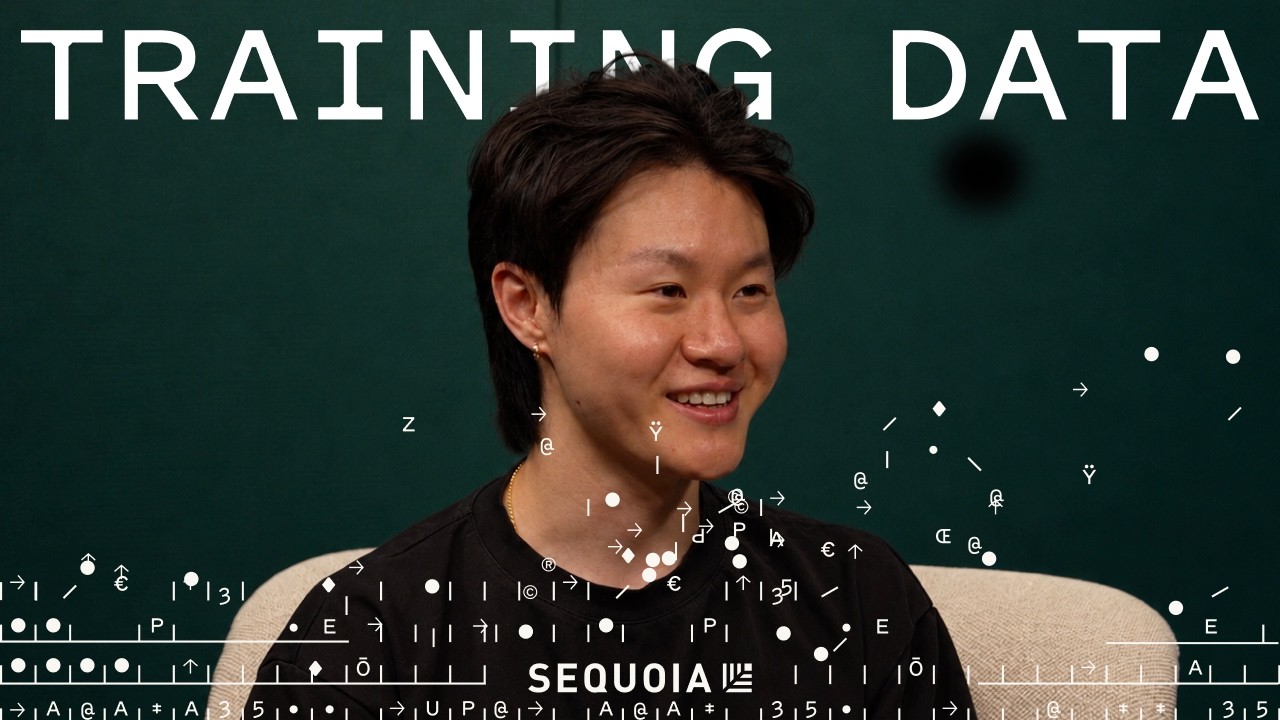
Recorded 20 October 2026 · 45 min
Robotics is fundamentally data constrained, and Josh, founder and CEO of Mecca, argues the gap can be closed by sensorizing humans: capturing first-person video, force and action data from people doing real work, then selling it to robotics foundation-model labs. His central claim is that robotics does not need a single breakthrough or trillions of hours up front. Each increment of data unlocks a new set of commercial tasks, and those tasks fund and generate the next increment.
The host, Sonia, pushes on the weak point. A car has 2-3 degrees of freedom, a hand has dozens, and force data adds more, so the required data could reach billions or quadrillions of hours. The conversation turns on whether a data factory's economics, quality control and hardware logistics can survive that arithmetic, and what Mecca becomes once deployed robots start generating their own data.
Humans as fleet learners — ▶ 8:48
Mecca's founding bet on egocentric (first-person) video came from a diagnosis in late 2024: teleoperation, with humans controlling robots to demonstrate tasks, was hard to scale, and GPT showed that scaling required far more data. Josh's reasoning was that humans and humanoids look alike, so people could become a Tesla-style learning fleet. The earliest pilot was a mobile app where Chinese aunties and uncles filmed themselves cooking and cleaning. Ego4D, with about 4,000 hours of human demonstration data, looked to the founders like proof of broad use cases even at that small scale.
Force data needs new hardware — ▶ 11:00
Video cannot capture how hard a hand squeezes a door handle or twists a bottle cap. Wrist cameras that show hand-object contact are a substitute, but Josh calls them a hacky way to infer force in Newtons. Mecca is building tactile gloves because labs asked for force data and nothing off the shelf reliably measures it in daily use. He treats force as incredibly important, and a data company that wants to supply it must also be a hardware company.
A data factory is logistics — ▶ 12:25
Contributors arrive through a direct-to-consumer app that streams tasks like cleaning a bedroom or cooking breakfast, and through a B2B channel recruiting bakeries or PCB lines. Josh says the harder part is the engine behind them. Mecca designs and produces hardware across 3-4 product cycles, distributes it to thousands of homes and businesses, runs 100 gigabyte upload lines to handle what he describes as hundreds of petabytes, then applies quality gates and computer vision. A heat map of jobs and industries guides which contributors to recruit next.
Fraud and moving quality targets — ▶ 15:26
Quality is a moving target, Josh says, because real-world edge cases keep producing things never seen before and Mecca learns quality lessons that were not true a week earlier. Fraud is an underestimated problem because the company creates data that does not yet exist rather than filtering the internet. One contributor submitted YouTube footage of someone working at McDonald's as original work. His prescription combines heuristics that escalate quickly, presence where collection happens, and incentive models that reward good contribution.
Defending the intermediary margin — ▶ 17:48
Asked whether a competitor could squeeze Mecca by paying contributors directly, Josh argues contributor payments are not the largest cost in making data useful end to end. He expects differentiation from verifiably high-quality data at scale, through hardware, operations and software. He also frames each data type, such as podcasting footage, as one SKU among many whose mix will change, for instance moving from average restaurants toward Michelin-star ones. He offered no margin figures, so the durability of this moat rests on his reasoning alone.
Scale gap and commercial unlocks — ▶ 19:23
The industry has moved from Ego4D's 4,000 hours two years ago to millions of hours, but Josh says it is still many orders of magnitude from where it must be. Tesla spent over a decade on 2 degrees of freedom with millions of cars. The host asked whether billions or quadrillions of hours are even affordable. Josh's answer is that it is not binary: scaling laws give people the courage to scale, and in-domain post-training data can close the gap to roughly four nines of reliability task by task. He gave no cost estimate.
Home data, constrained deployment — ▶ 22:02
Home data is the easiest to collect, but the home is among the hardest places to deploy a robot, with benchmarks and evals needed to ensure a robot does not fall on a baby. Josh expects early deployments in constrained, goal-oriented settings with existing SOPs: industrial cleaning bots, hotel delivery robots (already widely deployed in China and Southeast Asia), and pick-and-place packaging tasks he expects to be solved within 1-2 years. Mecca spent over a year and a half on laundry folding, which he expects to be solved in the near term.
Deployment flywheel and Mecca's pivot — ▶ 24:46
A Tesla FSD-style flywheel, where deployed robots return failure and correction data, is still a while away in Josh's view. It starts only as commercial tasks get solved. When it arrives he expects Mecca to look different: a broader data supplier (the Michelin-star and edge-case SKUs) and a deployment platform that collects domain data, post-trains models and supports enterprises. He compares this to a modern systems integrator, a traditionally tight-margin, competitive role, now one where an installed robot can learn to do something it could not do days earlier.
The data soup recipe — ▶ 32:02
Josh says the field has converged on a mix: roughly a million hours of human data across egocentric and other modalities, tens of thousands of hours of another data category (unclear in the transcript), and a few hours of in-domain demonstration data, with last-mile teleoperation also in the mix. A year ago, many argued only UMI data or only egocentric data would work. He now calls the mix a data pot of soup and declines to follow any one religion, since tactile data and simulation have yet to join it and will probably matter.
AlphaGo analogy and world simulators — ▶ 34:14
To the objection that watching millions of hours of tennis will not beat Roger Federer, Josh points to AlphaGo: large-scale behavior cloning of expert players came first, then self-play produced move 37. The difficulty in robotics is that the rules of the game are the entire physical world, and no world simulator can recreate it today. Egocentric data grounds basic physics and behavior cloning and may help build such a simulator. He expects a hybrid of self-play in the real world and in simulation, and sees value in models that can dream a dropped cup shattering.
Frontier labs and vertical models — ▶ 38:55
Asked whether AGI labs will steamroll pure-play robotics companies, Josh says the labs have the courage to scale imperfect data and that general models, now with robot data in their training mixes, will generalize well. He calls strong robotics performance from frontier models quite expected for that reason. He also expects arguments for vertical, targeted robotics foundation models that reach four nines of reliability on specific tasks. He does not claim pure-play companies will win, only that specialization remains viable and omni-modal inputs such as force and action will broaden what generalists can do.
Josh's argument is that robotics' data shortage is a problem of sequencing, not of total cost. Mecca does not expect to collect trillions of hours before robots become useful. Instead, he says, each increment of data unlocks a commercial task, and that task funds and generates the next increment. The host framed the sharpest version of the objection: a car has 2-3 degrees of freedom, a hand has dozens, force data adds more, so the requirement might reach billions or quadrillions of hours. She asked whether the world has enough GDP to pay for that. Josh did not offer a number. He offered a path instead.
That path starts with egocentric video, filmed by humans from a first-person point of view. Josh's founding reasoning was that teleoperation, where humans control robots to produce demonstrations, was hard to scale, and that humans and humanoids look alike. People could therefore become a Tesla-style fleet of learners. The numbers show the speed of change and the distance left to go. Ego4D offered about 4,000 hours of human demonstration data two years ago, while the industry is now in the millions of hours. Yet Josh notes that Tesla, working on only 2 degrees of freedom with millions of cars on the road, has far more video than that. He still places robotics many orders of magnitude short.
Video alone does not close the gap, and this is where Mecca's identity as a data company starts to blur. Force is the clearest example. Wrist cameras can show contact between hand and object, but Josh calls that a hacky route to knowing how many Newtons it takes to twist a bottle cap. Nothing off the shelf measured it reliably, so Mecca built tactile gloves, a sensor hub and camera-equipped baseball caps. Producing and distributing that hardware means 3-4 product cycles, logistics across thousands of homes and businesses, and 100 gigabyte upload lines to handle what Josh describes as hundreds of petabytes. An editorial inference follows: Mecca's defensibility, if it exists, lies in operations and hardware iteration more than in the raw footage.
Quality control reinforces that point. Josh calls quality a moving target, since the real world keeps producing edge cases and Mecca learns things about diversity and quality that were not true a week earlier. Fraud, he says, is underestimated because the company is creating data that does not yet exist rather than filtering the internet. One contributor submitted YouTube footage of someone working at McDonald's as his own. When the host asked about margin squeeze from competitors who pay contributors directly, Josh replied that contributor cost is not the largest factor in making data useful. He expects differentiation through verifiably high-quality data at scale. No margin figures were offered, so that argument is untested in the conversation.
On the question of what the training recipe looks like, Josh sees convergence and resists dogma. A year ago, many insisted that only UMI data or only egocentric data would work. Now he describes a mix of roughly a million hours of human data, tens of thousands of hours of another data category the transcript does not identify, and a couple of hours of in-domain demonstration data, with last-mile teleoperation also in the picture. He calls the whole thing a "data pot of soup" and says tactile data and simulation have yet to be added. That final slice matters most commercially: in-domain data collected in the actual environment is how he expects to reach roughly four nines of reliability.
Because reliability is task-specific, deployment will begin in constrained settings rather than homes. Josh concedes the paradox that home data is easiest to collect while the home is among the hardest places to deploy, with the baby-falling-risk the example he gives of why evals must mature. He expects early traction in industrial cleaning robots, hotel delivery robots, and pick-and-place packaging tasks, which he thinks will be solved within 1-2 years. He notes that hotel robots are already widely deployed in China and Southeast Asia. Mecca spent more than a year and a half on laundry folding, and he believes it will be solved in the near term.
Deployment also changes what Mecca sells. A Tesla FSD-style flywheel, in which fielded robots return failures and corrections, is still some way off, Josh says. When it comes, he expects Mecca to look different: still a data supplier across many SKUs, but also a platform that collects domain data, post-trains models and supports enterprises. He compares the role to a modern systems integrator, traditionally a tight-margin, competitive business. The difference is that an installed robot could acquire new capabilities after installation. It is a plausible direction, but it is Josh's aspiration for the company, not a demonstrated business model.
The deepest technical question is how robots move beyond imitation. Josh invokes AlphaGo, where behavior cloning of expert players preceded the self-play that produced move 37. Robotics lacks the equivalent of Go's fixed rules, because the rules are the entire physical world, and no world simulator can recreate it today. He says egocentric data grounds basic physics and may help build one, and he expects self-play in both simulation and reality. He also sees value in world models that can dream a dropped cup shattering. This is a hypothesis about how learning will progress, not an observed result.
That logic extends to frontier labs. Josh does not see their strong robotics performance as surprising, because robot data is now in their training mixes. He thinks omni models taking force, pixels and action as inputs are promising, yet he also expects specialized robotics foundation models to reach four nines of reliability on narrow tasks. He never claims pure-play robotics companies will beat the AGI labs. His position is closer to the idea that both generalists and specialists will need his product, which is also, naturally, the position of a data supplier.
The unresolved issue is how far the current mix actually carries. Josh says scaling it by an order of magnitude would solve many constrained tasks, but he also says that is not what the ultimate solution looks like, pointing to tactile, omni-modal and even smell inputs. His forecast of many orders of magnitude more robots than people in a decade or more comes with no stated mechanism. If the incremental path holds, early tasks generate revenue and data that pay for harder ones. If the long tail demands far more data than early deployments return, collection cost and quality control remain the binding constraints.
The open question. Josh says scaling the current data mix by an order of magnitude would solve many constrained tasks, but he also says that is not what the full solution will ultimately look like. He names tactile data and omni-model inputs as missing ingredients without saying how much data is needed, what it costs, or whether it is affordable. The host's GDP question went unanswered with any figure. The open issue is whether the incremental path of simple tasks, then deployment data, then in-domain post-training reaches four nines of reliability on the long tail before collection costs outrun the revenue those tasks generate.
Watch the full video at https://www.youtube.com/watch?v=0idrTKCDhuE.
Comments ()