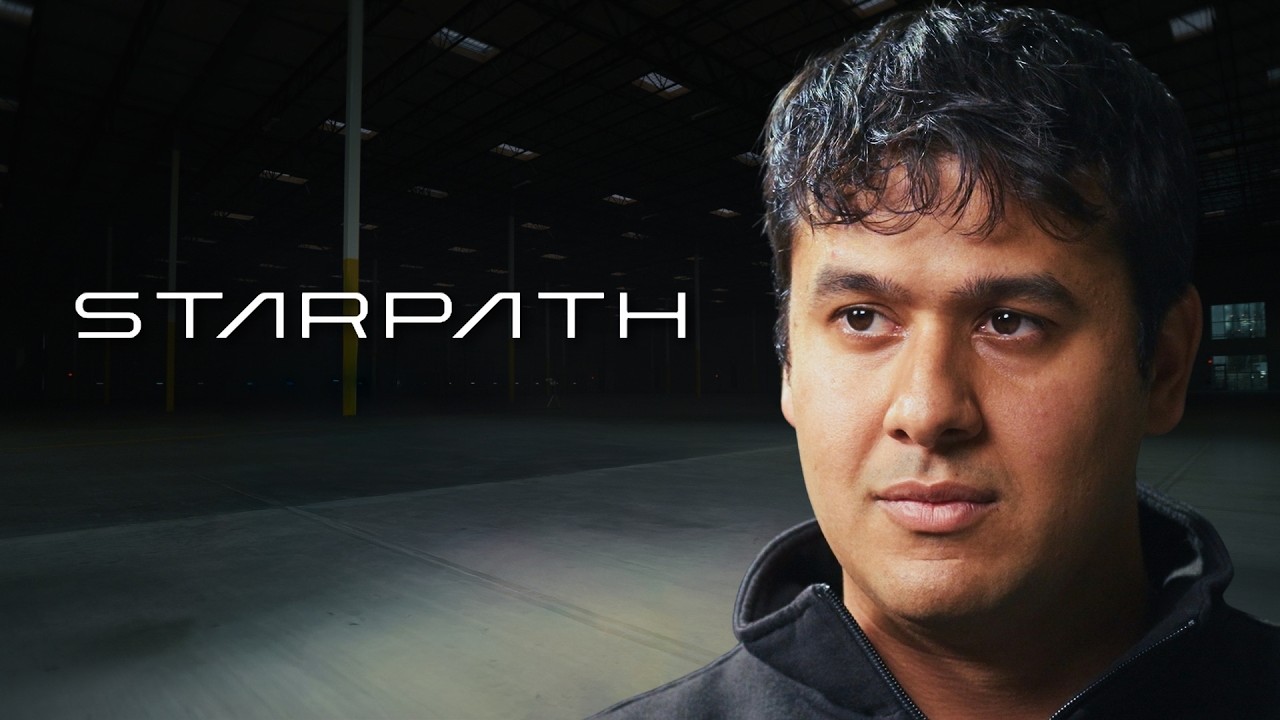
Recorded 29 October 2026 · 58 min
Saroj Sharaf, founder and CEO of Starpath, argues that the binding constraint on putting AI data centers in orbit is launch, not solar power or chips. In his telling, only a fully reusable, two-stage rocket can deliver the cost and volume that orbital compute requires. The only credible owner of one, SpaceX, has no rational reason to sell capacity to rivals.
The tension is that Starpath's own business, selling ultra-thin, low-cost solar panels to satellite builders, depends on a launch market Sharaf says does not currently exist. He describes a date at which Starpath would build a rocket company itself, while also building factories years ahead of demand. His claims come from a founder with a commercial stake, and several rest on his own estimates.
Demand flips to 99% — ▶ 2:10
Launch demand today is essentially telecommunications. Starlink is the most common satellite and, by Sharaf's account, the only space service broadly paid for by humans, requiring on the order of 100 Falcon 9-class rockets a year. He expects the mix to invert, with AI data satellites at roughly 99% of demand and telecom at 0.1-1%. Serving that second category requires launch that is far cheaper and much larger in scale, which he says by definition means a fully reusable rocket. The ratio is his forecast, offered without supporting data.
A market without supply — ▶ 3:38
Sharaf says SpaceX will not sell traditional launch under almost any circumstances, offering only niche products such as lunar launch and one called Starfall. Roughly 10 competitors are chasing Falcon 9 rather than Starship, and some sell service on rockets that do not yet exist. He calls it possibly "the worst market of any kind," because it looks as though supply exists and is growing, but no amount of money can actually buy it.
The rational monopolist — ▶ 5:25
Asked why a company that can scale launch would ever sell it, Sharaf concedes the logic: if you hold the bottleneck to what you consider the most valuable technology ever, and demand far exceeds supply, margins are extreme and a rational economist would not sell. He sees two futures. In one, competition emerges, which he considers probable. In the other, one company owns all superintelligence capacity with no motivation to cut prices or improve quality.
Safe until about 2029 — ▶ 7:21
Sharaf splits the future at roughly 2029-2030, when AI satellites become the majority of satellites by aggregate size or power. In the first phase Starpath faces no problem. SpaceX sold Falcon 9 launches to many of its customers before exiting the market. Rivals should moderately catch up to Falcon 9's capability: 10-100 flights a year, 10 tons per launch, and economics of a rocket that is not fully reusable. The concern is the second phase.
The $5-per-watt arithmetic — ▶ 9:39
A ground data center costs $10-15 per watt, Sharaf says, so an orbital one must reach about $5 per watt all-in, with roughly $1 for launch. For a 200 kW satellite costing $1 million ($800,000 to build, $200,000 to launch) at an optimistic 1,000 kg, launch must cost $200 per kilogram. Falcon 9 sold at single-digit thousands of dollars per kilogram and cost SpaceX about $1,000, making it 5x off. At 2 MW per launch, 2 GW takes 1,000 launches, 10x short on scale.
Why nobody sells first — ▶ 13:46
Only two companies, SpaceX and Stoke Space, are seriously developing fully reusable two-stage rockets. Sharaf's game-theory claim is that each owner of a working rocket faces the same incentive: deploy its own data satellites because superintelligence is valuable. The logic breaks once two companies sell, since competition then forces others. He once hoped for two sellers, then for one, and now sees zero, with nobody wanting to be first.
A launch company, conditionally — ▶ 15:25
Starpath has an internal date at which it will build a launch company if the market does not fix itself, which Sharaf said on record for the first time. SpaceX entering, or several players bidding competitively on large contracts at $200, $300, or even $500 per kilogram, would avert it. He reversed himself in 3 months: he still believes Starship will create near-infinite supply, but a friend's questions made him ask whether none would be available. He then opened a spreadsheet and began designing a rocket.
Solar panel as OLED — ▶ 21:51
Sharaf says Starpath cut space solar cost about 50x by starting from a clean sheet. Panels from 2010 cost $300-1,000 per watt, built from rare materials for low-volume buyers. His approach borrows OLED display manufacturing, using common materials in printed or deposited ultra-thin layers, which he calls an organic light-absorbing diode. The panel is roughly paper-thin versus 10-30 sheets for typical space panels, which he says could make a 200 kW satellite about one-third the weight. The recipe is withheld, so the claims cannot be assessed.
Overbuilding for capacity — ▶ 31:09
Starpath's roughly 130,000 sq ft Long Beach-area factory will produce 50 MW a year, against about 50 MW of total annual satellite wattage including Starlink and about 5 MW excluding it. Sharaf says customers asking how fast Starpath can reach 75 GW a year, 1,500x the plant, want capacity above all. Demand grows exponentially while capacity grows in steps, so he builds the steps above the curve. Next comes a 1.2 GW fab in Austin. The cost of capital, he argues, is less than "the cost of losing."
Vendors balk at data-sat prices — ▶ 40:57
Roughly half the new factory will make products beyond solar modules, most unreleased. A satellite bus has about 10 major components, and Sharaf says vendors cannot meet data-satellite prices: offered $100 million upfront for 100,000 thrusters costing $50,000-80,000 each, they would not take the challenge. Starpath's panels carry an idiot index of about 6 at top volume, versus hundreds in space solar. With one $8 billion contract at stake, he wants customers not to fail for lack of suppliers.
AI pays for Mars rockets — ▶ 50:21
Sharaf argues superintelligence makes rocket development economically rational. He frames a $5 billion rocket as about 2 weeks of Anthropic's annualized revenue run rate. That pays for the technology but not the operating expenses. A Mars base needs roughly 1,000 Starships, against about 100,000 flights for an AI data satellite constellation. He estimates a Mars city would cost 10x-100x less than before, since rocket, solar and power electronics already exist. Starpath began as a Mars company before selling to satellite builders.
Sharaf's thesis is that orbital AI compute will be limited neither by demand, chips, nor panels, but by who is willing to sell launch. He expects the satellite population to invert. Telecommunications satellites, which dominate launch demand today and require on the order of 100 Falcon 9-sized rockets a year, would fall to between 0.1% and 1% of the total, with AI data satellites making up 99% or more. That ratio is his forecast, not a measured figure, but the reasoning that follows is concrete. A vehicle serving the second category must be far cheaper and far larger in scale than anything flying now, which in his view means both stages must be reusable.
The arithmetic is what makes the claim sharp. By Sharaf's figures, a ground data center costs $10-15 per watt, so an orbital equivalent must reach about $5 per watt all-in, with roughly $1 of that for launch. For a 200 kW satellite costing $1 million, that leaves $200,000 for launch. At an optimistic 1,000 kg, the target is $200 per kilogram. Falcon 9 sold for single-digit thousands of dollars per kilogram and cost SpaceX about $1,000, so it is 5x off on cost. At 10 tons per launch it also falls 10x short on scale, since 2 GW would take 1,000 launches while data-center builders deploy 1-10 GW a year.
The surprise is not that the rocket is hard but that nobody sells one. Sharaf says SpaceX recently left the launch market and will not sell traditional services, offering only niche products such as lunar launch and one called Starfall. Roughly 10 rivals are chasing Falcon 9's capability rather than Starship's, and some sell service on rockets that do not exist. The result, he says, "might actually be the worst market of any kind," because it looks like supply exists and is growing, while money cannot buy any. His near-term exposure is limited. Through roughly 2029 or 2030, Falcon-class economics suffice for his customers. The risk begins when AI satellites become the majority.
Why would this persist? Sharaf offers an incentive argument rather than a technical one. Anyone who owns the bottleneck to what they believe is the most valuable technology ever made, in a market where demand far exceeds supply, enjoys extreme margins, and a rational economist would advise against selling. Each owner of a working reusable rocket would reach the same conclusion and deploy its own satellites. Only two companies, SpaceX and Stoke Space, are seriously developing fully reusable two-stage rockets. He adds that the equilibrium is fragile: once two companies sell, competition forces the rest. He once hoped for two sellers, then for one, and now sees none, with no one eager to go first.
Sharaf frames the stakes politically as well as commercially. In one future, competition emerges, which he calls the probable outcome. In the other, a single company owns all superintelligence capacity and has no motive to lower price or raise quality. He says he is not against big companies, only against important technologies going uncompeted, and asks whether anyone wants superintelligence owned by something effectively like the government. He did not always think this way. Three months ago he assumed Starship would create near-infinite supply, and he still believes it will. A friend's questions led him to ask whether supply could exist and still be unavailable. Having asked rocket companies what they would sell, he concluded that "we will soon be starving on the banana plantation."
The commitment that follows is unusual for a component supplier. Starpath has an internal date at which it will build a launch company if the market does not repair itself, a plan Sharaf said on record for the first time in this conversation. SpaceX entering the market, or several players competitively bidding large contracts at $200, $300, or even $500 per kilogram, would cancel it. He insists the reasoning was "less math and more logic," and he does not understate the difficulty, noting that rocket engineering and manufacturing are extremely hard. His motive, he says, is that Starpath's customers cannot succeed in the present market. Whether the date is firm or rhetorical is unclear, and no technical plan was disclosed.
The credibility of that pivot rests on Starpath's claimed manufacturing advantage. Sharaf says it cut space solar cost about 50x. Panels from 2010 cost $300-1,000 per watt, built from rare materials for buyers who bought small volumes and did not care about cost. Starpath started from a clean sheet and chose common materials and printed or deposited ultra-thin layers, drawing on OLED display manufacturing. He calls the result an organic light-absorbing diode. The panel is roughly as thin as paper, against 10-30 sheets for typical space panels, which he says could cut a 200 kW satellite to about one-third the weight. Its list price is $15 per watt, with large-volume prices an order of magnitude lower. He withheld the recipe, so none of this can be checked.
Starpath's capacity strategy follows from the same demand picture. Sharaf says total annual satellite wattage is about 50 MW including Starlink and about 5 MW without it. Yet the Long Beach-area plant, a 130,000 sq ft site coming online in about 5 months at 50 MW a year, is 10x the non-Starlink market. His reasoning is that the word customers repeat is capacity. They ask how fast Starpath can reach 75 GW a year, which is 1,500x the plant. Demand grows as a smooth exponential while capacity arrives in steps, so he builds the steps above the curve. A 1.2 GW fab in Austin is next. The cost of capital, he argues, matters less than "the cost of losing."
The same logic drives a push beyond solar. A satellite bus has about 10 major components, and Sharaf says vendors cannot meet data-satellite prices. He describes offering $100 million upfront for 100,000 thrusters costing $50,000-80,000 each and finding vendors unwilling to try. Starpath's panels carry an idiot index of about 6 at top volume, which he says is unheard of in space, against hundreds elsewhere. With an $8 billion contract in play, he does not want customers to fail for lack of suppliers. He calls the impulse a hospitality mindset. The editorial inference is that Starpath is vertically integrating wherever the supply chain would cap its own revenue, with launch as the extreme case.
Sharaf's most expansive argument is that the problem creates its own solution. If superintelligence demand is as large as he expects, building a $5 billion rocket becomes rational, a sum he compares to about 2 weeks of Anthropic's annualized revenue run rate. That would pay for the development of the rocket, though not its operating costs. A Mars base needs roughly 1,000 Starships against about 100,000 flights for an AI constellation, so he expects a Mars city to cost 10x-100x less than before. Starpath itself began as a Mars company. The logic holds only if the rocket exists and its owner permits others to use it, which is the very condition in doubt.
This account deserves scrutiny for its source. Sharaf is a supplier with a commercial stake in launch being available and cheap, and the $200 per kilogram target depends on a satellite mass he calls optimistic. SpaceX's position reaches the reader only through his characterization and the interviewer's reference to Elon Musk's comments. There is also tension between his two predictions: the game theory says owners will hoard capacity, while he calls competition the probable future. The decisive evidence would be a second company selling reusable launch at scale, or Starpath's internal date arriving without one.
The open question. Does a second seller of fully reusable launch ever emerge? Sharaf's argument depends on a game-theory prediction that every owner of a working rocket will hoard capacity, yet he also calls competition the probable outcome. He does not reconcile the two, and SpaceX's own view is absent from the conversation. The $200/kg target rests on a satellite mass he calls optimistic. The sharpest test is whether any provider offers large-volume launch at $200 to $500 per kilogram before Starpath's internal deadline arrives, and whether Starpath could credibly build a rocket company if none does.
Watch the full video at https://www.youtube.com/watch?v=QEACSjIYPrg.
Comments ()