
Recorded 22 October 2026 · 57 min
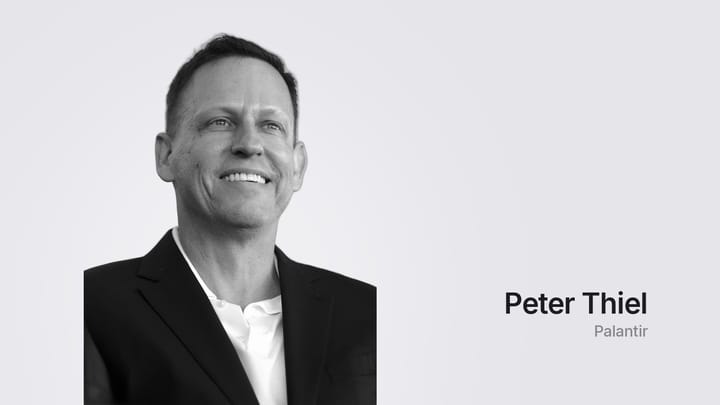
Peter Thiel's strongest idea is that the AI-safety debate has a blind spot: the cure. Doomers lay out detailed extinction scenarios but wave at global regulation. Thiel says that vagueness should make us worry about a totalitarian one-world state, his "Antichrist", as much as about Armageddon. A world with no outside left cannot decay the way the Soviet Union did.
Walter Isaacson interviews the PayPal co-founder and Founders Fund investor for his series The Builders. He asks whether power has concentrated in founders who lack a stable moral compass. Thiel answers that AI will drive growth, that competition keeps it from becoming a monopoly, and that the alternative to a charismatic founder is a bureaucrat.
The tension is that he wants to hit the accelerator while conceding that existential risks are real. He also admits he cannot say what really drives the people building AI.
Backlash is overdetermined — ▶ 3:30
Nobody knows who wins and loses from AI. Thiel expects it to add a lot to growth, but "in a fairly disruptive kind of a way," and the dystopian science-fiction scenarios are "not entirely unreasonable." The fear has a lineage. After Demis Hassabis sold DeepMind to Google, Elon Musk and Sam Altman founded OpenAI as a quasi anti-Google, on the logic that the technology was too dangerous for one company. Musk exits around 2018. By roughly 2020 seven people leave OpenAI to start Anthropic and take the risks even more seriously.
The cult that built Anthropic — ▶ 7:00
In the 2000s, East Bay futurists adjacent to the new atheists argued AI was close and might be a hardware problem: once chips got powerful enough, it would arrive, transformative and dangerous. Thiel finds parts "crazy and almost cultlike," but credits the good dimension of a cult, knowing one big thing others did not. His test: has a cult ever built a company worth close to $2 trillion at IPO, the sixth or seventh largest in the world, in six or seven years? His steelman of effective altruists: AI is around the corner and could become misaligned.
Not a monopoly — ▶ 9:27
AI will raise productivity and be disinflationary, and the median person should gain unless a few companies capture it. Thiel asks every company why it has a monopoly, and AI pitches are "incredibly weak" on that story. Leadership has rotated from DeepMind to OpenAI to Anthropic, now in pole position, with Google, Meta and Grok not far behind and possibly China. It is "a fight to the death," so benefits should spread widely. The anxiety is still rational: a 3% wage gain with plus-or-minus 10% volatility, in a society that hates risk.
No pause, accelerate — ▶ 14:04
Thiel broadly agrees with David Sacks and Trump that competition with China rules out pausing. He fears high-tech totalitarianism that "knows more about you than you know about yourself." He is "still not in the pause button camp" and wants to "hit the accelerator as hard as possible." AI is needed to control AI, so the Hugging Face scare makes staying ahead more urgent. Not innovating is dangerous too: if China leapfrogs, it may weaponize AI against the US. What makes him uneasy arguing it publicly is that the big labs themselves urge a slowdown.
Growth versus zero-sum — ▶ 16:36
Thiel defines the middle class as people who expect their kids to do better, and says millennials and Gen Z have rightly lost that expectation. Outlawing AI, as if the internet had been outlawed, would leave virtually no growth: more like Europe or Japan, a society with "a loser for every winner." Globalization was labor arbitrage, working when Chinese workers earned 5% as much as Americans and turning zero-sum as the gap closes. Technology raises per capita GDP. The internet "wasn't big enough." AI, he says, is bigger.
Doom odds and regulatory theater — ▶ 20:17
A 5-10% chance of everyone dying sounds "way too high." Thiel does not think it will happen, and people's probabilistic intuitions are poor. A bunker would not help anyway. On regulation, the labs know more than a government that cannot do it, so asking for rules may let them off the hook. He told Mark Zuckerberg, hauled before eight congressional committees, "they don't want to regulate you. They want to yell at you." Dario Amodei's warnings also motivate staff: they tell employees they work at "the greatest most important company in the history of the world."
Antichrist, not just Armageddon — ▶ 23:43
Asked about his line that the Antichrist would take power by convincing everyone the apocalypse is coming, Thiel takes "a victory lap." He concedes real existential risks: nuclear, climate, AI. His addition is a "softly totalitarian one world government." With no outside left, it could not decay as the Soviet Union did. Antichrist means a tyrant ruling the world: in the 17th century through weapons, now through fear of technology, with environmentalism pushing for global regulatory authority. Greta Thunberg is not the Antichrist. Oppenheimer's push for UN control of nuclear weapons partly worked.
The handwavy cure — ▶ 28:27
Eliezer Yudkowsky's If Anyone Builds It, Everyone Dies is precise on risk scenarios but "completely handwavy" on how to regulate globally, which he insists is required. Thiel's inference: that vagueness alone says to worry more about the Antichrist than Armageddon. He prefers his religious frame to the atomic scientists' 1945 slogan "one world or none," which signs people up for world government "without asking any questions." Antichrist or Armageddon makes both equally bad and pushes toward a moderate third way, not an immoderately powerful UN. He admits the language also got attention.
Bimodal companies — ▶ 32:15
On tech billionaires' power, Thiel says the alternative to a charismatic founder is a bureaucrat with an MBA and a board that never wants to do anything. Those are the only two kinds of companies. After Jobs, Apple had by far the lowest R&D spend and the largest share buybacks, a "pure well-run value stock." Tim Cook was the "anti-Jobs," a zero-charisma efficient operator. Both can be good for shareholders, but Jobs or Elon Musk are "way better for society." He says he probably likes winning "too much."
Evil beats bad — ▶ 48:01
Thiel ranks good over evil, but evil over bad. The antonym of good may be incompetent rather than immoral, and a Lada is worse than a Ferrari. Society agrees, he says, citing the DMV. Conservatives lost the stem cell fight by calling it evil science that clearly worked, and won the 1990s art fight by calling it bad art, which got it defunded. Marlowe's Faustus is a fraud who goes to hell. Goethe's works with the devil, does more good than evil, and is saved. He still ranks a moral compass high and wants transcendent purpose, such as Mars.
Consciousness and relationships — ▶ 53:56
The AI question is "a question about us." Chomsky treated language as the core human ability, which looked safe until 2022. Thiel is vaguely Cartesian: AI is not conscious "or ever will be," and no computer would experience a sunset as a human does. Replacing humans would lose that, and the relational side too: families, companies, society. AI could improve that by freeing people from "robotic labor in a factory." Earlier, asked whether humanity's survival matters, he hesitated, then called it extremely important but not the only goal.
The cure for AI risk is the part nobody has specified, and Peter Thiel reads that gap as a warning. Eliezer Yudkowsky's case that AI could kill everyone is technical and detailed. His case for global regulation, which he insists on, is vague. Thiel's contrarian inference: "We're worrying about Armageddon. We're not worrying about the Antichrist." A debate that scrutinizes one catastrophe and waves through the institution built to prevent it is heading somewhere unexamined. Most of what else he says is either a consequence of that argument or a defence against the charge that it makes him reckless.
Start with why the second catastrophe might be worse. Thiel concedes that existential risks are real: nuclear weapons, climate, AI. But a softly totalitarian world government has a property the others lack. There is no outside left. The Soviet Union could decay because other countries remained. A planet-wide North Korea might last indefinitely. He is not against international authority as such. Oppenheimer's generation wanted nuclear weapons handed to a stronger UN, got partial controls instead, and Thiel judges the result more good than bad. His objection is to authorities nobody has thought through. Globalization got little scrutiny, and its costs arrived unplanned.
That is why he uses religious language. The atomic scientists' 1945 slogan, "one world or none," lets you sign up for world government without asking a single question. Recast the choice as Antichrist or Armageddon and both options become bad, which forces a search for a moderate third way. He adds that the political force in modern life is fear of technology, and that something like climate change sounds like it demands a global regulatory authority. The Antichrist, in his telling, arrives by persuading people the apocalypse is coming.
The practical consequence is that he will not pause. China is the first reason. He fears a high-tech totalitarianism that "knows more about you than you know about yourself," and he does not want that model to win. The second reason is that AI is needed to control AI, so recent scares make staying ahead more urgent. Not innovating is also a risk. If China leapfrogs the US, it may be tempted to use AI as a weapon. He says openly that he is uncomfortable arguing this, because the largest labs are the ones urging a slowdown.
He has a theory of why they do. The labs know more than the government, and the government does not know how to regulate. Calling for rules may let a company off the hook, because regulation will be slow. He told Mark Zuckerberg, then facing eight congressional committees, that Congress did not want to regulate Meta. It wanted to yell at it. Apocalyptic talk has a second audience: employees. When Dario Amodei calls the technology huge and dangerous, he tells his staff they work at "the greatest most important company in the history of the world." Thiel admits this reading may be too cynical.
The economic case rests on growth. Thiel defines the middle class as people who expect their children to do better, and says millennials and Gen Z have rightly lost that expectation. Outlaw AI and the US drifts toward Europe or Japan: no growth, and a loser for every winner. He separates tech growth from globalization. Globalization was labor arbitrage, which worked while Chinese workers earned 5% of American pay and turns zero-sum as the gap closes. Technology means doing more with less and raising per capita GDP. The internet was not big enough. AI, he thinks, is.
Who captures that growth depends on whether AI becomes a monopoly, and here he is sceptical. When founders pitch him AI companies, the monopoly story is "incredibly weak." Leadership has passed from DeepMind to OpenAI to Anthropic, while Google, Meta and Grok sit close behind and China may too. It is a fight to the death, which is the opposite of monopoly. He grants the anxiety is rational. A median gain can hide a 3% wage rise with plus-or-minus 10% volatility, and a society that hates risk sees the bad outcomes more clearly than the good.
The same logic shapes how he judges the people building it. Founders are the only alternative to bureaucrats, he says. Apple after Jobs spent by far the least on R&D and the most on buybacks, and Tim Cook was the "anti-Jobs." Thiel would rather have evil than bad, meaning an incompetent. Charisma may be dangerous, but a bland MBA is not safe. Society, he says, shows the same preference, and the DMV is his example. He still ranks a moral compass high and wants transcendent purpose, such as Mars.
The obvious objection is that this proves too much. Thiel faults Yudkowsky for vagueness about global regulation, yet his own third way is never named. He puts extinction odds at roughly zero, and calls people's probabilistic intuitions poor, but gives no test for when he would change his mind. Asked what drives Musk, Amodei or Altman, he says it is hard to say, that he has spent endless time on it, and that he scores them far more good than bad. That is a verdict, not an analysis. Asked whether humanity's survival matters, he hesitated before answering.
So the argument is only half built. If fear of Armageddon can summon the Antichrist, the question is what institution could manage AI without becoming one. Thiel says that question is being skipped. He has not answered it either.
The open question. Thiel faults Eliezer Yudkowsky for never specifying how global AI regulation would work, yet his own "moderate third way" between Antichrist and Armageddon is never named either. He puts the odds of extinction near zero, concedes he cannot read the builders' motives, and gives no mechanism by which accelerating avoids both catastrophes. Watch whether he ever describes the third way concretely, and whether his own dismissal of the doom probabilities faces the same test.
Watch the full video at https://www.youtube.com/watch?v=H9Bdv3t5VtQ.
Comments ()