
Recorded 15 October 2026 · 100 min
Nvidia sells to far more than the frontier labs. Jensen Huang says about a third of the business is classical computing, a third is thousands of startups renting compute, and only a quarter to a third is the labs everyone watches. The buildout therefore does not depend on OpenAI and Anthropic reaching trillions in revenue.
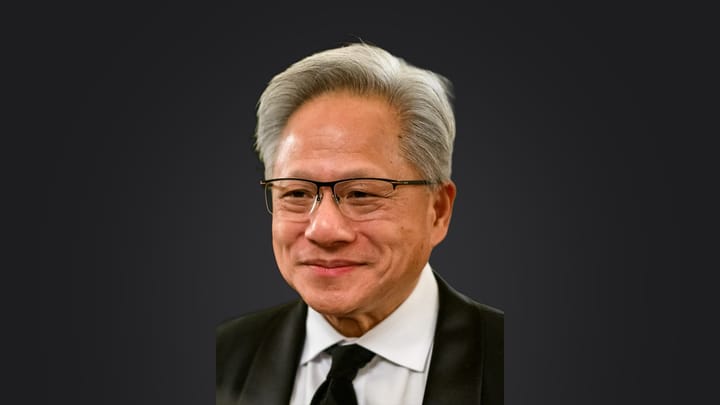
The conversation is with two investors, days after Huang received the National Medal of Science and attended the White House summit that produced the accord on superintelligence. It moves from agents and the falling cost of intelligence to physical AI, safety, the 2027 compute ramp and Nvidia's valuation.
The tension is between a physical constraint and a financial one. Demand outruns supply, yet land, power and shell may set the pace, while investors fear two labs cannot pay for it all. Huang's answer is that Nvidia's general-purpose, fungible architecture makes the risk much lower than it looks.
Immigration as superpower — ▶ 4:47
Five of the six people on stage for the National Medal of Science were born outside the US. Huang ties that to why America leads in creating intellectual property: "we attract the world's best," drawn by freedom, opportunity and a can-do culture where "of course" it's possible. He calls the inflow of ideas unlike anything the world has seen and the system "a delicate balance" that must be run lawfully. His own story fits: his father saw New York on a Carrier training trip, and Huang and his older brother were sent to the US ahead of their parents.
Why compute explodes — ▶ 8:26
Reasoning needs far more inference than regurgitating memorized answers. Models roll out several options, reflect, prune and repeat, like strategists who value optionality. Compute compounds twice: each job uses more, and a model that does jobs well gets hired for more of them. Scaling laws continue, but last year's unlock was the harness around the model: working memory, offline knowledge-graph building akin to sleep-time compaction, and tool use of SPICE, Verilog, Photoshop and AutoCAD. Coding was the first on-ramp. Design and creative work are next, such as turning a photo into CAD.
Navier-Stokes needed search — ▶ 15:55
The Navier-Stokes result didn't come from nothing. It rested on decades of work by mathematicians, and what was missing was exhaustive exploration. Huang's logic: if the answer hadn't required vast search, "people are pretty smart" and someone would have found it earlier. He thinks many fields sit on the same precipice, waiting for compute. The run used about 10,000 agents and roughly $4 million of compute by the hosts' math. That cost should fall another 5-10x, and it happened on only 2-3 gigawatts per lab.
Intelligence cost curve — ▶ 17:24
Huang expects the cost of intelligence to fall fast because there is more compute and smarter models are more efficient. He wants it to drop by 2x or even 20x a year, like three decades of Moore's law. GPT-1 would have cost about $20 million to train once. Today it would cost around $100, a drop he made in about 10 years. Meanwhile models grew to 3, 10 and 30 trillion, and use is up perhaps a million times. His view is that demand is "insatiable" because every answer opens new doors.
Abundance won't mean leisure — ▶ 20:45
Asked what people will do with abundance, Huang says "completely disagree" to the idea that AI buys more time. He thinks it unlocks opportunity, and ambitious people will pursue it. The hosts bring in Keynes's 1930 forecast: an economy 8x larger and a 15-hour week. The economy did grow 8x, yet people work far more. The explanation offered is that Keynes misjudged the human spirit, since work and discovery are purpose. Huang says he is working harder than ever and having more fun doing it.
Physical AI scale — ▶ 24:45
Huang says the $100 billion physical-AI estimate was understated. Nvidia reports $10 billion in physical AI in the first six months of this year, after a first $10 billion year and $5 billion the year before. The scope covers medical imaging, radar, robots, cars and surgical rooms. Building it takes three computers: one to train, one to simulate in a digital twin like Omniverse, and one inside the machine. He expects labs to build a digital twin of the internet too, so agents can learn to use it without being released onto it.
Zero trust containment — ▶ 30:48
Alignment is "a forever problem," because even "be successful in life" has endless cultural readings. So safety can't depend on perfect alignment. Huang's answer is engineering. Start with containment and zero trust, like a new hire or a baby in a playpen, with minimum rights that expand as confidence grows. Add monitoring that is out of band, because watched systems behave differently. It must be able to escalate or shut the system off. Nvidia's OpenShell for this has over 100 companies joining.
Safety is the product — ▶ 36:45
Huang rejects the idea that safety and capability are separable. Airbags, ABS and lane-keeping are part of the car's technology, so accelerating AI means accelerating security and safety. Dario Amodei told the president the labs are speeding up while safety keeps pace, and Huang says everyone in the room agreed. He argues the industry only just began to work, so deployment urgency is new, and that without safety "the functionality will never get a chance to speak." He adds that it is an existential issue for Nvidia first.
Three-legged stool — ▶ 43:07
The framework is described as a three-legged stool. Commerce reviews every frontier model before release. The White House accord brings internal and external audits, board oversight and liability. A new SI force led by Jay Clayton coordinates industry and cyber. The US has already pulled a model, Mythos, off the shelf under export-control authority. Huang says "first" beats "perfect": the steps are tangible, have teeth and are happening now. He knows of no other industry that built cross-company, government-to-industry coordination this early, and he asks critics to learn the problem first.
Land, power, shell — ▶ 48:00
The 2027 forecast is 43 GW of new AI compute, more than exists today, with another 40 GW the year after. Huang says demand is "there and more." The obstacle is moving from digital to physical: land permitting, power, skilled trades and local moratoriums. He expects land, power and shell to be the key constraint. Nvidia is least exposed because it sells to every cloud, neocloud and OEM and can shift supply. Demand also exists abroad, including a 2 GW Australia deal worth about $80 billion. Substrates and silicon photonics are also constrained.
More dollars per gigawatt — ▶ 53:35
When power is scarce, buyers choose the most productive compute, and Huang says Nvidia generates the most tokens per watt. Share is rising two ways. Nvidia now sells GPUs, networking, CPUs, storage and security, so content per gigawatt went from about $18 billion to $20-odd billion to over $40 billion. Its share of global capex was single digits six years ago. It is about 40% with the big cloud providers and about 80% with neoclouds and on-prem buyers, and both halves are doubling each year.
Three thirds of demand — ▶ 1:02:03
Huang splits Nvidia's business in thirds. Classical computing (data processing, simulation, XGBoost fraud detection at Visa and Mastercard, recommenders) is about a third and grows 30-40% a year with no AI at all. The frontier labs, five or six rather than two, are about a quarter to 30%. The rest is thousands of startups renting compute, and 80% of them use open models. He says it is "not even a debate" that this keeps going and that the market puts too much pressure on two labs, which needn't approach $1 trillion in revenue.
Moore's law is over — ▶ 1:08:59
Before AI, annual compute infrastructure spend was about half a trillion dollars. Huang expects $4 trillion a year of total infrastructure build by decade's end, with $1.5 trillion of it compute. His mechanism is that Moore's law is over. Twice the transistors once cost the same a year later, but now it costs twice as much, so more capacity means proportionally more dollars. General-purpose compute cost about $5 billion per gigawatt, and a Vera Rubin build costs about $50 billion. The only question is whether that delivers 10x more value. He wouldn't be surprised by $10 trillion in annual build and refresh.
Moat is trust at scale — ▶ 1:19:41
Huang argues the moat is widening. Customers would place a $100 billion order for Vera Rubin Ultra sight unseen, because the systems can't be benchmarked anymore and Nvidia always delivers. He compares it to TSMC, which gets 100% of his chip business because he can plan five years out. Fungibility is his answer to custom chips: "specialization is the enemy of fungibility," and of durability, so general purpose means rentability, financeability and lowest TCO. Consensus for 2027 moved from flat or shrinking a year ago to 74% growth.
Licensing and revenue share — ▶ 1:26:51
Huang names two growth vectors beyond hardware. First is enterprise software licensing, for companies without IT departments that need Nvidia on the hook for the SLA. At roughly $2,000 per GPU per year, with about 20 million GPUs shipped yearly and half going to enterprise, it adds up. Second is revenue share with clouds that rely on Nvidia for offtake, ecosystem and financing help. Nvidia spends over 50% of free cash flow on buybacks, and investing will fall as a share because the OpenAI and Anthropic opportunity "is not going to come around again."
The AI buildout does not rest on OpenAI and Anthropic. Jensen Huang's answer to the bubble question is arithmetic about who actually buys Nvidia compute. About a third of the business is classical computing: data processing, simulation, fraud detection at Visa and Mastercard, recommender systems. That third grows 30-40% a year with no AI labs involved at all. Another quarter to 30% goes to the frontier labs, and he counts five or six of them, not two. Meta, Gemini and Grok are on the list, and Anthropic joined this year. The remaining third goes to thousands of startups that rent Nvidia compute. Huang's verdict on the market's fixation is that it puts "way too much pressure" on two companies he still expects to be magnificently successful.
The pressure comes from a specific model. Take 40 GW of compute arriving next year and roughly $40 billion of revenue per gigawatt, and you get $1.6 trillion a year that the labs would have to fill. Lab revenue today is around $200 billion, and the investors' math says it must double to $400 billion and then $800 billion for payback on trillions of capex to pencil out. Huang calls extrapolating the labs into multiple trillions unnecessary. The labs don't have to be anywhere near a trillion dollars to succeed, and the infrastructure doesn't need them to be.
His case rests on the base, not the labs. Before AI, annual compute infrastructure spend was about half a trillion dollars. He expects $4 trillion a year of total infrastructure build by the end of the decade, with $1.5 trillion of it compute. The mechanism is that Moore's law is over. Twice the transistors once cost the same a year later. Now they cost twice as much. So every unit of extra capacity the world wants costs proportionally more. General-purpose compute cost about $5 billion per gigawatt, and a Vera Rubin build costs about $50 billion. The question is whether it delivers 10x more value. Without AI, he says, semiconductors were already on a path to become the largest industry in the world.
On top of that base sits the demand he thinks is nowhere near saturated. Reasoning is the engine. A model that thinks rolls out several options, reflects and prunes, and that takes vastly more inference than reciting something it memorized. Compute compounds twice, because each job uses more and a model that does jobs well gets hired for more of them. The harness around the model is the other unlock: working memory, offline knowledge extraction and tool use of the software humans already built. The Navier-Stokes result shows what follows. It took about 10,000 agents, roughly $4 million of compute by the hosts' math, and decades of prior work that only needed exhaustive search. Huang expects that cost to fall another 5-10x. He expects intelligence to get cheaper at 2x or even 20x a year. GPT-1 would have cost about $20 million to train once and would now cost around $100. Use is up perhaps a million times over the same decade. Cheaper intelligence, in his telling, means more ambition, not more leisure. Every answer opens doors, and people with ambition walk through them.
The startup third is where that ambition turns into rented compute. About 80% of those startups use open models, and they aren't competing with the frontier labs. They take models like Nvidia's Nemotron and teach them proprietary domain data in physical AI, biology, materials or manufacturing. Huang's picture is closed labs reaching general intelligence while vertical companies reach superintelligence in their own domains. Nvidia's physical AI business alone is $10 billion in the first six months of this year, after a first $10 billion year and $5 billion before that.
Why Nvidia captures this is a question of risk. Huang argues that at $50 billion per gigawatt, buyers need to know the infrastructure will be good for years whatever happens. His line is that "specialization is the enemy of fungibility." Nvidia runs every model, from flash attention to hybrid state-space models, across every cloud and region, so capacity can be re-rented if plans change. Customers would place a $100 billion order for Vera Rubin Ultra sight unseen, because the systems are too complex to benchmark and Nvidia has always delivered. He compares it to his relationship with TSMC, the one supplier he can plan five years out with. The numbers fit the claim. Content per gigawatt rose from about $18 billion to over $40 billion as Nvidia added networking, CPUs, storage and security. Its share of global capex was single digits six years ago, about 40% with the big clouds and about 80% outside them now. Consensus for 2027 went from flat or shrinking to 74% growth in a year.
The binding constraint, though, is physical. The 2027 forecast of 43 GW is more than all the AI compute that exists today, and Huang agrees demand is there. What he doubts is land, power and shell. Permitting, power generation, skilled trades and local moratoriums all slow the move from digital to physical. Substrates and silicon photonics are also short. Nvidia has the most room to adapt because it serves every cloud, neocloud and OEM, and can shift supply to wherever a site is ready, including 2 GW in Australia worth about $80 billion. When power is scarce, he says, buyers pick the most productive compute per watt, which pushes share toward Nvidia. It is a convenient result, and he admits he doesn't love that America can't keep up.
Safety, in Huang's account, is treated as engineering rather than a brake. Alignment is "a forever problem," since even "be successful in life" can mean a hundred things. So he does not depend on perfect alignment. He wants containment and zero trust, like a new hire or a baby in a playpen, with rights expanded as confidence grows. He wants monitoring from outside the system, because watched systems behave differently, with the power to escalate or shut down. Safety and capability are one package, like airbags and the car. The US framework, as described, has three parts: Commerce review of every frontier model, the White House accord with audits and liability, and a coordination force on industry and cyber. A model has already been pulled off the shelf. His argument is that acting on what is first beats arguing about what is perfect, and that without safety there is no industry to defend, a risk he says lands on Nvidia first.
Huang also names two ways to monetize beyond hardware. Enterprise software licensing, at roughly $2,000 per GPU per year across the half of 20 million annual GPUs that go to enterprise, is one. Revenue share with clouds that depend on Nvidia for offtake and financing support is the other. Together they turn the installed base into recurring income. Nvidia is also putting more than 50% of free cash flow into buybacks.
The obvious objection is that the argument is clean and the evidence is partial. Asked directly whether the labs can keep 2-3x'ing revenue, Huang says "Oh, yeah," then moves to the composition of Nvidia's business. That answers whether Nvidia is exposed, not whether the labs can pay. The startup third also carries weight it hasn't earned yet. Those startups rent compute, and the transcript never shows who funds them or what they earn. Nvidia itself invests in and finances customers, and plans revenue share with clouds. Huang concedes the OpenAI and Anthropic investments won't come around again, and says investment will fall as a share of cash flow. He also cannot test demand directly, because supply is constrained and he is allocating less than customers asked for. The same consensus that missed 2027 by 100-200% is evidence that forecasting this market is hard in both directions.
So the question left open is not whether demand exists. It is which part of it is paid for by revenue and which by capital, and whether land, power and shell, not demand, will decide how fast any of it arrives.
The open question. Huang answers whether the labs can keep 2-3x'ing revenue with "Oh, yeah" and then reframes the question rather than give a path. The reframe leans on a startup third that rents compute, and the transcript never shows who funds those startups or what they earn. Nvidia also backs customers through investments, financing support and planned revenue share. He concedes the OpenAI and Anthropic stakes won't come around again. Watch whether that startup third pays its own way once Nvidia's investing slows.
Watch the full video at https://www.youtube.com/watch?v=eS7qQ3WJSrw.
Comments ()