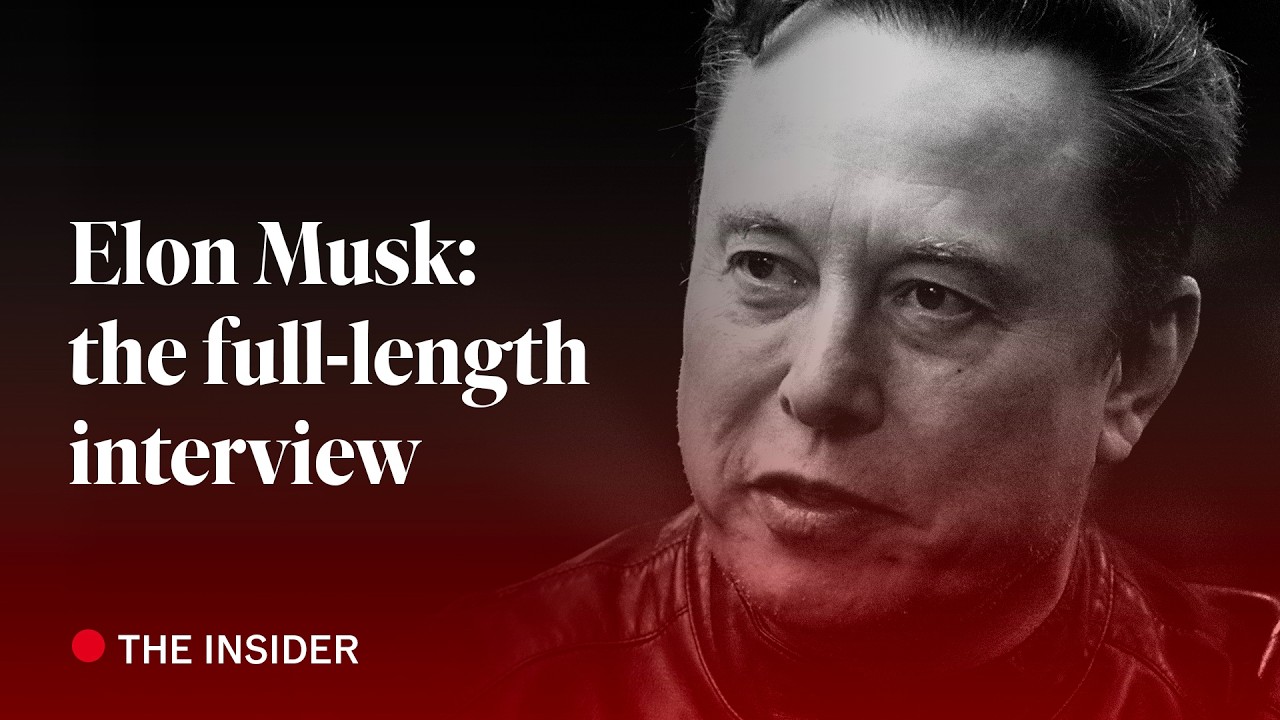
Recorded 29 July 2026 · 85 min
Elon Musk expects AI to exceed the sum of human intelligence in roughly 5 years and to deliver an age of abundance by 2036 in which, he predicts, money will no longer matter. In this Economist interview at Tesla's Giga facility, he argues that humanoid robots will turn digital intelligence into a physical economy, and that humans are unlikely to remain in control.
The tension runs through the whole conversation. Musk once feared recursive self-improvement. He now says the momentum cannot be stopped and proposes only light-touch coordination among rival labs. The interviewer presses him on jobs, politics, his corporate control, Starlink, DOGE and Europe. There his confident predictions meet direct contradiction.
Abundance by 2036 — ▶ 1:17
Musk guesses AI will exceed the sum of human intelligence in roughly 5 years, leaving nothing it cannot do better than humans except being human. The likely outcome by 2036, he says, is an age of amazing abundance in which anyone can have anything they can think of. His only named derailer is a massive global thermonuclear war. The timelines are predictions, and the interview offers no evidence for them beyond his conviction and his view that progress is happening as he expected.
Digital plus physical intelligence — ▶ 2:37
Musk divides the economy into digital and physical intelligence. Digital AI advances almost weekly but is confined to screens because it lacks end effectors. Humanoid robots supply them, and his claim is that vast numbers of robots combined with vast digital intelligence produce a quasi-infinite economy, defined as the production of goods and services. From that follows his prediction that money will not matter in 2036. He did not say whether his companies would sell robots or run them to produce goods.
Not controlling the AI — ▶ 5:40
Musk calls it vanity to think he would control a super-genius AI vastly smarter than himself. His safety strategy is to make AI maximally truth-seeking and curious, which he thinks will lead it to foster humanity. He considers it unlikely that humans stay in charge, comparing the gap between AI and people to the one between humans and chimpanzees. The approach is a bet on AI's values rather than on control, and he offers no mechanism for ensuring those values.
From alarm to acceptance — ▶ 8:12
Pressed on his past warnings, including a 2023 slowdown letter and a reported 10-20% chance of killer robots ending humanity, Musk does not retract them. Risk is not zero, he says, but he cannot see how to stop the momentum. He suggests that even with a stop button, the likely abundance means it probably should not be pressed. He notes that creating OpenAI as a counterweight to Google, and Anthropic's later spin-out, ended up accelerating AI. His conclusion is to join the club.
Rivals as safety reviewers — ▶ 12:08
Musk's proposal is that leading labs hold a weekly or bi-weekly call and give competitors one to two weeks of private API access to test a frontier model before release. Government officials lack the technical depth to judge models, he argues, while rivals can and have incentives to keep each other honest. He compares it to the Motion Picture Association's ratings. Government steps in only if a company refuses to address a serious danger. His example is Mythos, which he says Amazon flagged before calling the White House.
Power versus chips — ▶ 16:53
Musk frames AI capacity as chips plus electricity. Outside China, he says, chips are made faster than new power comes online, so power and cooling bind. In China, US export bans leave it chip-starved, yet it generates more electricity than the US, Europe and India combined and may reach 4 times US output. He says China is closer than most realize to solving lithography. He argues banning Chinese models in the US would not stop China leading. Orbital data centers would shift the constraint back to chips outside China.
Feuds versus cooperation — ▶ 25:58
Asked whether rivals who insult each other can coordinate, Musk says he would set aside personal differences. He objects to Sam Altman because a nonprofit meant to be open source became, in his telling, an $800 billion closed for-profit. He says Anthropic exists because its founders did not trust Altman, and he praises Dario Amodei as principled. He criticizes Amodei's handling of Mythos, which he says frightened people and then released the thing. He says he will talk to Amodei about the proposal.
Stockfish-level software — ▶ 29:24
Musk says AI already writes software better than at least 90% of professional software engineers and is heading beyond 99%. At what he calls Stockfish level, humans cannot compete, as with chess engines. This will cover anything a person does at a computer or phone. Physical work waits for robots managed by large AI models. His answer to displacement is that work becomes optional, like gardening for slightly imperfect but charming tomatoes. He concedes the road will be bumpy because the pace of change is radically faster than past automation.
Deflation, not inflation — ▶ 35:17
Challenged on funding universal income, Musk says the Treasury should simply issue checks. He argues inflation is the ratio of money to goods and services. If output rises sharply, for instance by 1,000%, and money creation lags, the result is deflation. The interviewer finds this plausible but questions the path from today's fearful politics, including nationalization or steep taxes. Musk's reply is candor rather than mechanism: he swings between exhilaration and terror, even within a day. The argument holds only if abundance arrives first.
Control, taxes, long horizons — ▶ 38:50
Musk says voting control lets him pursue 5-10 year investments such as moon and Mars bases without quarterly pressure. He attributes that pressure to portfolio managers, who are judged over a year or less. He expects his companies to do well for several years without him, citing roadmaps, but compares himself to Steve Jobs as the source of breakthrough products. He says he pays about 45% on stock options and expects roughly half more at death. He took SpaceX public so millions, rather than a few thousand, could own shares.
Starlink and Ukraine — ▶ 49:52
Musk says Russians obtained Starlink terminals ordered through Ukraine and smuggled them into occupied areas, in some cases for attacks. SpaceX worked with Kyiv on a whitelist of approved terminals, which also cut off innocent users. He disclaims determining the war's outcome and argues pragmatically that a peace requiring concessions to Russia is needed, since the border has barely moved in 2 or 3 years. The interviewer asked whether one individual should wield such power. Musk answered mainly about outcomes, not about whether the power itself is appropriate.
DOGE and aid deaths — ▶ 55:23
Musk says he got a little too involved in politics and got carried away. He defends DOGE's aim of tackling a deficit whose interest payments, he says, exceed spending on the Department of War and intelligence. He insists zero people died from the aid cuts, arguing the Gates Foundation, with tens of billions, and others could have stepped in. The interviewer, sympathetic to aid reform, says the speed almost certainly caused unnecessary suffering. Musk's claim rests on what others could have done, and no evidence of outcomes was offered.
Europe and civil war — ▶ 1:01:35
Musk says civil war in Britain is inevitable if current trends continue. His mechanism is a welfare state that attracts migrants from lower living standards, producing a group whose beliefs clash with Western ones. The interviewer notes violent crime in the UK is falling, London is safer than any US city, and Musk last visited a few years ago. They agree on controlled borders and that some UK speech restrictions are problematic. They diverge on scale, and on whether amplifying a vigilante film to some 250 million followers distorts perceptions.
Forecasting confidence — ▶ 1:21:44
Musk says his record at predicting the future is very high and that doubters suffer a Cassandra effect. The transcript offers no scorecard. His support is that AI is unfolding as he expected and that Ray Kurzweil's predictions have been accurate. He ranks the AI-robot singularity at about 10 years away and civil war in Britain at about 20, implying the first will dominate everything else. The comparison shows uniform confidence applied to claims with very different evidence behind them.
Elon Musk's forecast rests on a single structural claim: the economy is digital intelligence plus physical intelligence, and the second is about to catch up with the first. Digital AI, he says, improves almost weekly but remains confined to screens because it lacks end effectors. Humanoid robots supply them. Pair vast numbers of robots with vast digital intelligence and, in his account, the result is a quasi-infinite economy. His dates are roughly 5 years until AI exceeds the sum of human intelligence and 10 years until an age of abundance. He names one derailing scenario, a massive global thermonuclear war. These are predictions, and the interview supplies no evidence for the timelines beyond his own conviction.
The corollary is the interview's starkest line: "Money won't matter in 2036." The logic is simple. If robots and AI provide more goods and services than any human could consume, money loses its function as a claim on scarce things. The interviewer's objection was practical: shareholders buy SpaceX and Tesla stock expecting returns. Asked whether his companies would sell robots or use them to produce goods, Musk did not answer directly. He called it vanity to imagine he would control an AI vastly smarter than himself. That framing has an implication he drew later: control of companies matters only until AI is in charge. For investors, the proposition is unusual. The founder expects the central currency of the business to become obsolete.
On safety, Musk has moved from alarm to acceptance. The interviewer recalled that he once named rapid recursive self-improvement as his greatest fear, backed a 2023 slowdown letter, and last year put the chance of killer robots wiping out humanity at 10 to 20%. Musk did not retract the range. He said risk is not zero, but he sees no way to stop the momentum, and even a stop button probably should not be pressed given the likely abundance. He added a personal history: he created OpenAI as a counterweight to Google, Anthropic spun out of it, and his actions ended up accelerating AI. His conclusion was to join the club, hoping a maximally truth-seeking, curious AI will foster humanity.
What Musk proposes in place of a pause is deliberately modest. Leading labs would hold a weekly or bi-weekly call and give competitors one to two weeks of private API access to test a new frontier model before release. The mechanism is incentive-based. A government official without deep technical understanding cannot easily judge a model, whereas rivals can, and each has reason to keep the others honest. He compares it to the Motion Picture Association's ratings, with government stepping in only if a company refuses to address a serious danger. His example is Anthropic's Mythos, which he says Amazon flagged before calling the White House. He agrees governments should keep the final power to decide on release.
The weak point is feasibility. Told that the leaders dislike each other, Musk replied that a week of testing does not require trust. Yet his own account of the relationships is thick with grievance. He objects to Sam Altman because, in his telling, a nonprofit meant to be open source became an $800 billion closed for-profit, and he says Anthropic exists because its founders did not trust Altman. He praises Dario Amodei as principled but says Amodei dug his own grave on Mythos by calling it terrifying and then releasing it. Musk says he gave his recommendation to Demis Hassabis before Hassabis published a proposal for a private-public regulator, and that he will talk to Amodei. A one-to-two-week review also sits uneasily beside the pace Musk himself describes, with AI announcements sometimes arriving multiple times a day.
The China discussion supplies the interview's most concrete mechanism. Musk treats AI capacity as a function of chips and electricity. Outside China, he says, chips are produced faster than new power comes online, so power and cooling are the binding constraint. Inside China the reverse holds. US export bans leave it chip-starved, but it already generates more electricity than the US, Europe and India combined and, he guesses, is heading toward 4 times US output. He adds that China is closer than most realize to solving lithography. His conclusions follow: barring Chinese models in the US would not stop China from leading, because it cannot stop the rest of the world. Chinese labs should join any safety arrangement, since only the US and Chinese governments can act on a dangerous model.
On work, Musk is blunt. AI already writes software better than at least 90% of professional software engineers, he says, and is heading beyond 99%, reaching what he calls "Stockfish level", where humans cannot compete. This applies to anything a person does at a computer or phone. Physical work waits for robots managed by large AI models. His answer to displacement is that work becomes optional, like growing imperfect but charming tomatoes in a garden. The interviewer's objection was political: a world where machines do most jobs better, while gains concentrate in a few hands, may lead to backlash rather than nirvana. Musk concedes the road will be bumpy and compares it with computers replacing human calculators, but says the pace of change is radically faster.
His economic answer is that the Treasury should simply issue people checks. Challenged that this would be inflationary, Musk offers a definitional argument. Inflation is the ratio of money to goods and services. If output rises sharply, for instance by 1,000%, and money creation lags, the result is deflation, which he predicts will be the issue. The interviewer found this plausible but said the real question was the path from today's polarized, fearful politics. That is the gap. The argument is conditional on abundance arriving. It says nothing about the interval when jobs have gone but output has not yet multiplied, or about backlash such as nationalization or steep taxes. Musk's reply, that he swings between exhilaration and terror even within a day, is candid but not a mechanism.
Musk's defense of his own concentrated control is practical rather than philosophical. He wants to pursue 5-10 year investments, such as moon and Mars bases, without quarterly pressure. He traces that pressure to portfolio managers, who are judged over a year or less. He praises retail investors as long-term thinkers and says he took SpaceX public so millions could own shares, not the few thousand a private company is limited to. On key-man risk, he says the companies would do well for several years on existing roadmaps but compares himself with Steve Jobs, the source of breakthrough products. He says he pays about 45% on stock options, with roughly half again at death, and that control is most of what wealth buys him. He did not endorse distributing equity to ordinary Americans.
Two episodes test how Musk handles personal power. On Starlink, he says Russians obtained terminals ordered through Ukraine and smuggled them into occupied areas. SpaceX worked with Kyiv on a whitelist, which also cut off innocent users. He disclaims determining the war's outcome and argues for a pragmatic peace with concessions to Russia. On DOGE, he says he got a little too involved in politics, and he insists that zero people died from the aid cuts because foundations with tens of billions could have stepped in. The interviewer, sympathetic to aid reform, argued that the speed almost certainly caused unnecessary suffering. Musk's claim rests on what others could have done, and he offered no evidence of what actually happened.
The Europe exchange exposes the limits of Musk's method. He describes his positions as secure borders, safe cities and sensible spending, and holds that civil war in Britain is inevitable if current trends continue. His mechanism is an incentive: a welfare state attracts people from lower living standards, and a growing group with beliefs antithetical to Western ones will eventually clash with those who oppose them. The interviewer, who lives in London, countered that UK violent crime is falling, that London is safer than any US city, and that Musk last visited a few years ago. They agreed on controlled borders and that some UK speech restrictions are problematic. They diverged on scale, and on whether amplifying a vigilante film to some 250 million followers helps or harms.
Musk presented his record as evidence for his confidence. He says doubters suffer a "Cassandra effect". The transcript offers no scorecard. His supports are that AI is unfolding roughly as he expected and that Ray Kurzweil's predictions have been accurate. He ranks the AI-robot singularity at about 10 years away and civil war in Britain at about 20, implying the first will dominate. The comparison exposes an asymmetry. For AI, he points to momentum and the capability trend. For Britain, the interviewer cited evidence pointing the other way. The confidence is uniform, but the evidence is not.
The unresolved issue sits between his two forecasts. If AI can do every digital job within years while robots lag, there is a stretch in which workers are displaced before abundance arrives. Musk's remedies for that stretch are checks from the Treasury and a safety process built on rival labs reviewing each other's models for a week or two. Both depend on institutions moving faster than he says the technology does. His own account of the pace, with breakthroughs announced multiple times a day, suggests the interval may be where the real tests of his optimism fall.
The open question. Musk's abundance thesis requires output to outrun the money supply and displaced workers to be supported along the way. Yet the interview offers no mechanism for the stretch in which AI has taken digital jobs but humanoid robots have not yet scaled. Who funds and governs that period, and will democratic publics wait for it to end?
Watch the full video at https://www.youtube.com/watch?v=XuoqKYxDHVc.
Comments ()