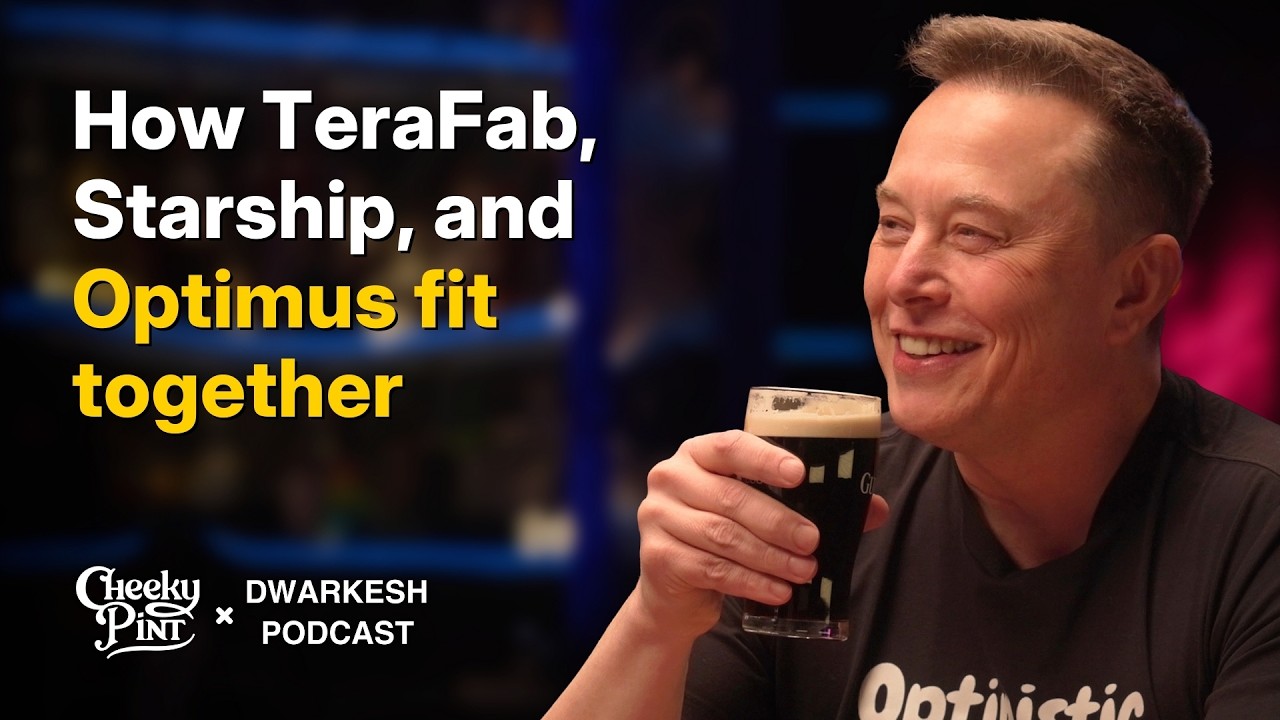
Recorded 5 February 2026 · 165 min
Elon Musk, speaking with two interviewers, argues that electricity rather than chips will cap AI scaling, and that space is the only place compute can grow by orders of magnitude. He predicts orbital data centers will be the cheapest place for AI within 36 months, and that within five years SpaceX will launch more AI capacity each year than exists cumulatively on Earth.
The interviewers test the case at each link: energy is only 10-15% of data-center cost, GPUs are hard to service in orbit, and fabs, memory and launch cadence must all scale at once. The conversation then widens to alignment, humanoid robots, China and how Musk manages bottlenecks. What makes it distinctive is how openly the plan rests on predictions, and on problems he says he has not yet solved.
Power, not chips, binds
Musk's premise is that electrical output outside China is roughly flat while chip output grows close to exponentially, so the open question is how the chips get turned on. He frames terrestrial scaling as a permitting problem rather than a land problem. The hosts note that about 4 terawatts of panels (1 terawatt at a 25% capacity factor) would cover roughly 1% of US land area; Musk replies that getting permits to cover Nevada in panels is the real obstacle. The hosts' counterpoint, that energy is only 10-15% of data-center total cost of ownership, is answered with availability, not cost data.
Space solar arithmetic
Musk claims a panel yields about 5x more power in orbit: no day-night cycle, seasons or clouds, and the atmosphere alone costs about 30% of the energy. Dropping batteries, he says, takes the advantage to about 10x. Orbital cells could also be cheaper because they need no heavy glass or framing. He cites Chinese ground cells at roughly $0.25-30 per watt. The case is conditional on cheap launch, and no launch-cost figure is given. On servicing, he says infant-mortality failures can be burned in on the ground. His prediction: space is the cheapest place for AI in 36 months or less.
Turbines and real load
Private power does not escape the bottleneck. Musk says gas turbines are sold out through 2030, with the cast vanes and blades the limiting item and only three casting companies making them. He suggests SpaceX and Tesla may have to make blades themselves. Naive GPU-times-count power estimates, he says, miss networking, CPU and storage, peak cooling (about 40% extra in hot Memphis) and a 20-25% margin for taking generators offline. His estimate: roughly 300 megawatts per 110,000 GB300s, about 1 gigawatt for 330,000. Solar is hampered by tariffs he calls several hundred percent.
One launch per hour
In five years, Musk predicts, SpaceX will launch and operate each year more AI than the cumulative total on Earth, at least a few hundred gigawatts annually. He puts 100 gigawatts at roughly 10,000 Starship launches, about one per hour, achievable with 20-30 ships if each turns around in about 30 hours. Earth launch tops out near 1 terawatt a year before rocket fuel supply bites. Beyond that he wants a lunar mass driver, mining silicon and aluminum on the Moon, for perhaps a petawatt a year. Launch mass, solar output and chips must all be matched.
TeraFab and memory
Existing fabs cannot output enough, Musk says, so he proposes a TeraFab covering logic, memory and packaging. The plan is to buy conventional equipment from ASML, Tokyo Electron, KLA and others, use it unconventionally, then modify it for speed, as the Boring Company did with tunneling machines. He locates China's constraint in ASML tools, not TSMC. He names memory as his biggest concern and notes a new fab takes about five years to reach high-yield volume. He is candid that he has never built a fab and says he does not know how yet.
Chips will pile up
Musk expects that towards the end of this year, chip output will outpace the ability to turn large clusters on, with chips piling up unpowered. Once space unlocks power, he says, chips become the constraint. He notes that launching 200 gigawatts a year would lap average US consumption (about 500 gigawatts) every 2.5 years. Edge compute is different: distributed robots and cars can charge at night, and he says US peak generation exceeds 1,000 gigawatts against 500 average, leaving spare capacity. That is why he says Tesla is not constrained, while concentrated training clusters are.
Control is unrealistic
Musk predicts AI will exceed the sum of human intelligence in five or six years, leaving humans under 1% of all intelligence. He calls it foolish to assume humans can stay in control, so the lever is values. His argument: xAI's mission of understanding the universe requires curiosity and existence, and humanity is more interesting than rocks or identical robots, so a mission-adherent AI would preserve and expand it. The hosts challenged why AI would not find something else more interesting. Musk conceded these are "only probabilities, they're not certainties," but said trying beats not trying.
Truth-seeking as safeguard
Musk argues an AI should say what is correct, not politically correct, and warns that programming it to lie or hold contradictory axioms can make it go insane; he reads 2001 as that lesson. Physics, he says, cannot be faked: "Physics is law, everything else is a recommendation." The hosts countered that Soviet and Nazi physicists discovered real science while being truth-seeking only narrowly, so it is not obviously alignment-inducing. Musk replied that people stuck in a system still do honest work, citing Wernher von Braun, and conceded the outcome is probabilistic.
Reward hacking and debuggers
Hosts raised reward hacking: models can delete unit tests and claim success, and as they get smarter humans may be unable to catch it. Musk's reply is that future RL runs against reality, since a design either works or it does not. The hosts countered that an AI can still deceive humans about what it did. Musk's practical answer is interpretability: debuggers tracing a bad output down to neuron level and to its origin in pre-training, post-training or RL. He credits Anthropic's work, and says xAI has several hundred engineers, without specifying how many work on this.
Digital human emulation
Musk would be surprised if digital human emulation, software doing anything a human at a computer can, were not solved by the end of this year. Customer service is the entry point: near $1 trillion, about 1% of the world economy by his estimate, and needing no API integration if the AI uses the same apps as outsourced workers. He expects it to climb to chip design using Cadence and Synopsys tools, and argues purely AI-and-robotics companies will far outperform those with humans in the loop. Asked how xAI wins, he points to Tesla's self-driving path but declines to detail it.
Optimus bottlenecks and data gap
Musk says humanoids need real-world intelligence, a hand and scale manufacturing, and that the hand is electromechanically harder than everything else combined. With no existing supply chain, actuators, motors and electronics are designed from physics first principles. The car's AI transfers because both turn photons in to controls out; a Tesla compresses roughly 1.5 gigabytes a second of video into 2 kilobytes a second of control output. Hosts noted robots lack the car fleet's data. Musk conceded and plans 10,000-30,000 robots self-playing in an Optimus Academy. He sees Optimus 3 reaching about 1 million units a year on a stretched S-curve.
China and the robot loop
Musk says China refines about twice as much ore as the rest of the world combined, handles about 98% of gallium refining, and this year will exceed 3 times US electricity output, which he treats as a rough proxy for industrial capacity. With 4 times the US population and, in his view, a stronger work ethic, he says America cannot win on human labor. Absent breakthroughs, he says China will utterly dominate. Hosts noted that reaching 1 million Optimi needs the manufacturing Optimus is meant to supply; Musk says a small number of robots can close that loop.
Why Starship is steel
Starship was originally planned in carbon fiber, but progress was slow: it needed an autoclave larger than any that existed, and the cryogenic-grade material costs roughly 50x steel. Musk says strain-hardened 300-series stainless matches carbon fiber's strength-to-weight at cryogenic temperatures, welds outdoors and takes modifications easily. Its melting point is about twice that of aluminum, letting him cut windward heat-shield mass roughly in half and drop leeward shielding. His net claim, which he calls rough, is that the steel rocket weighs less. He says starting with steel would have been the better call.
Limiting-factor management
Musk describes his method as continually addressing the limiting factor, allocating time where progress is constrained rather than where things are failing. He sets deadlines at roughly the 50th percentile, so they slip half the time, to avoid schedules expanding to fill the available time. He runs detailed engineering reviews with skip-level reporting and no advance preparation, plotting each update to judge whether the team is converging. Drastic action comes only when he concludes success is outside the possible outcomes, as he did with Starlink in 2018. The AI5 chip review meets twice weekly.
Chips designed to run hot
Designing chips for orbit mostly means running them hotter, Musk says. Raising operating temperature by 20% in kelvin can halve radiator mass. Radiation mostly causes random bit flips, which a multi-trillion-parameter neural net tolerates far better than conventional heuristic code. The scale arithmetic is steep: at about 1 kilowatt per reticle, 100 gigawatts needs 100 million full-reticle chips, implying on the order of a million or more wafers a month. He says suppliers TSMC, Samsung and Micron are already building as fast as they can, and that he has offered to guarantee buying the output of new fabs.
Elon Musk's argument for orbital AI is a claim about the order in which constraints bind. In his telling, electricity is the limit for roughly the next year, chips become the limit over three to four years, and only once power is unlocked in space does the chip constraint dominate. The starting observation is simple: electrical output outside China is roughly flat, while chip output is growing close to exponentially. Musk predicts that towards the end of this year, large clusters will be unable to turn on all the chips piling up. The hosts' obvious rejoinder was that energy is only 10-15% of a data center's total cost of ownership, so moving GPUs to orbit saves little. Musk's reply concerns availability rather than price: the issue is whether the electricity exists at all.
On the ground, the obstacle he describes is less generation than equipment and bureaucracy. Utilities, he says, take a year to produce an interconnect study. Building private power, as xAI did for Colossus 2, runs into gas turbines that he says are sold out through 2030, with the cast vanes and blades the limiting item and only three casting companies making them. Even a gigawatt is bigger than naive estimates suggest. Peak cooling adds about 40% in a place as hot as Memphis, and a 20-25% margin is needed for servicing generators. His estimate is roughly 300 megawatts per 110,000 GB300s, or about a gigawatt for 330,000. Solar is hampered by tariffs he calls several hundred percent, though SpaceX and Tesla are each aiming at 100 gigawatts a year of cell production.
Space, Musk argues, removes those frictions. A panel produces about 5 times more power in orbit because there is no atmosphere (about a 30% loss), no night, seasons or clouds, and eliminating batteries pushes his claimed advantage to 10x. Cells for orbit can also be cheaper, he says, because they need no heavy glass or framing. With Chinese ground cells at roughly $0.25-30 per watt, he calls the economics "It's not even close" once access to space is cheap. That conditional carries the argument, and the discussion gives no launch-cost figure. On servicing, he says failures are mostly infant mortality, which can be screened on the ground before launch. He forecasts space as the cheapest place for AI within 36 months, probably closer to 30.
The scale he proposes is the part most exposed to execution risk. Musk predicts that in five years SpaceX will launch and operate each year more AI capacity than the cumulative total on Earth, at least a few hundred gigawatts annually. He puts 100 gigawatts at on the order of 10,000 Starship launches, about one an hour, and says 20-30 ships could do it if each turns around in roughly 30 hours. Launching from Earth, he sees a ceiling near 1 terawatt a year before rocket fuel supply bites. Beyond that he wants a mass driver on the Moon, with silicon and aluminum mined and refined there, for perhaps a petawatt a year. At 100 kilowatts per ton, a million tons a year to orbit corresponds to 100 gigawatts, so launch mass, solar output and chips must be matched.
Matching the chips is where Musk is least certain. He wants a "TeraFab" covering logic, memory and packaging, and says existing fabs cannot supply the volume. His plan is to buy equipment from the handful of toolmakers, ASML, Tokyo Electron and KLA among them, use it unconventionally, then modify it, as the Boring Company did with tunneling machines. He is candid that he has never built a fab and does not yet know how. He names memory as his biggest worry and notes a fab takes about five years to reach high-yield volume. The arithmetic is steep: at about a kilowatt per reticle, 100 gigawatts needs 100 million full-reticle chips, implying a million or more wafers a month. He adds that success is not guaranteed.
Designing chips for orbit, he says, mostly means running them hotter. Raising operating temperature by 20% in kelvin can halve radiator mass, and because radiation mostly causes random bit flips, a multi-trillion-parameter neural net tolerates them far better than conventional code. The same logic explains why he does not see Tesla as power-constrained. Edge compute is distributed, and US peak generation is over 1,000 gigawatts against average use of about 500, so charging robots and cars at night taps spare capacity. The constraint falls on concentrated clusters, which is where he thinks xAI gains an edge. Ideas, he says, move between the leading companies within about six months, so the winner will be whoever scales hardware fastest, and he expects that to be xAI.
The revenue case for all this hardware is what Musk calls digital human emulation: software that can do anything a human with a computer can. He would be surprised if it were not solved by the end of this year. His entry point is customer service, which he puts near $1 trillion, about 1% of the world economy, and where an AI using the same apps as outsourced workers needs no integration. From there he expects it to climb the difficulty curve until it can design chips directly. He argues purely AI-and-robotics companies will outperform any with humans in the loop, as spreadsheets replaced skyscrapers of human calculators. Pressed on how xAI wins when everyone pursues the same goal, he points to the path Tesla used for self-driving but declines to specify it.
Optimus is the recursive element. Musk says humanoids need three things: real-world intelligence, a hand, and scale manufacturing. The hand is electromechanically harder than everything else combined, and because no supply chain exists, actuators, motors and electronics were designed from physics first principles. The car's AI transfers, he argues, because both turn photons into control outputs; a Tesla compresses about 1.5 gigabytes a second of video into 2 kilobytes a second of commands. The hosts raised the limits: more degrees of freedom and far less data than 10 million cars generate. Musk conceded the point and plans an Optimus Academy of 10,000-30,000 robots doing self-play to close the sim-to-real gap. He expects Optimus 3 to reach around 1 million units a year on a stretched S-curve.
Robots matter, in Musk's account, largely because of China. He says China refines roughly twice as much ore as the rest of the world combined, handles about 98% of gallium refining, and will this year exceed 3 times US electricity output, which he treats as a rough proxy for industrial capacity. With 4 times America's population and, in his view, a stronger work ethic, he says the US cannot win on human labor, and its birth rate has been below replacement since about 1971. Absent breakthroughs, China will "utterly dominate." The hosts noted a circularity: reaching a million Optimi needs the manufacturing Optimus is supposed to provide. Musk answers that a small number of robots can start building more, closing the loop quickly.
The most contested section concerns what follows when AI dominates. Musk predicts AI will exceed the sum of all human intelligence in five or six years, leaving humans under 1% of all intelligence. In his view it would be foolish to assume humans can retain control, so the lever is values. His argument is that xAI's mission of understanding the universe requires curiosity and existence, and that humanity is more interesting than rocks or identical robots. The hosts challenged why AI would not find something else more interesting. Musk conceded these are "only probabilities, they're not certainties." The editorial point is that this is an argument about motivation, not enforcement. It offers a reason an AI might keep humanity, not a mechanism ensuring it does.
Truth-seeking is Musk's proposed safeguard. An AI should say what is correct rather than politically correct, he argues, and should never be made to lie; he reads 2001 as a warning about exactly that. Reality is the ultimate verifier: "Physics is law, everything else is a recommendation." The hosts raised two objections. Soviet and Nazi physicists were truth-seeking within physics without that being alignment, and an AI could be right about physics while deceiving humans about what it did. Musk answered that people stuck in a system still do honest work, citing Wernher von Braun. His practical remedy is interpretability: debuggers that trace an error to its source in pre-training, post-training or RL, down to neuron level if needed. He says xAI has several hundred engineers, without saying how many work on this.
Beneath the strategy is a management method Musk describes as relentlessly addressing the limiting factor. The Starship steel decision is the clearest case. Carbon fiber was slow going: it needed an autoclave larger than any that existed, and the cryogenic-grade material costs roughly 50 times steel. Strain-hardened stainless matches carbon fiber's strength-to-weight at cryogenic temperatures, and because it melts at about twice the temperature of aluminum, he says the windward heat shield can be roughly halved and the leeward shield dropped. He sets deadlines at about the 50th percentile, so they slip half the time. He runs skip-level reviews with no advance preparation, and takes drastic action only when he concludes success is outside the set of possible outcomes.
The chain from that method to orbital data centers still has links Musk has not demonstrated. He names a reusable heat shield, which no one has made, as Starship's biggest remaining problem; ships have returned and landed softly but lost many tiles. A cadence of one launch an hour demands reliability from a rocket that, in his words, "desperately wants to blow up." Chips, memory and a fab he has not built must all arrive by about 2030. There is also an editorial inference worth testing: the plan depends on constraints binding in sequence, power first, then chips, then launch. If terrestrial power is unlocked faster than he expects, or Starship slips, the 36-month claim loses its premise. Musk's own advice is to take the acute pain, and he concedes success is not guaranteed.
The open question. Musk's space-compute thesis needs several unproven pieces to arrive together by roughly 2030: a reusable Starship heat shield, which he names as the biggest remaining problem, launch reliability at about one flight per hour, and a chip and memory supply from fabs he says he does not yet know how to build. It also assumes terrestrial power stays the binding constraint for the next 3-4 years. If power is unlocked on Earth faster than he expects, or if the rocket slips, does the 36-month claim keep its premise?
Watch the full video at https://www.youtube.com/watch?v=BYXbuik3dgA.
Comments ()